Generate thousands of R&D and application hypotheses from technical documents, and formulate strategies using conceptual structural models.
Searching through academic papers, patents, and technical news to identify new R&D themes is a standard practice. Many believe that if they gather information comprehensively and exhaustively—and analyze it using the right methods—they will inevitably arrive at the correct answer. Recently, tools known as “Technology Intelligence” (TI) have emerged to support this process. Yet, despite these resources, the frustration of failing to uncover new research themes or hypotheses remains a persistent issue.
Please take a moment to consider this: you can only search for things when you already know the names or keywords, right?
The real reason you cannot find R&D themes or hypotheses is that you are limiting your search to an information space confined to your own area of expertise. If a hint for a new technology lies in an industry or technical field different from your own, you wouldn’t yet know the name of that field or the keywords you should be searching for, would you?
How do you search for something you don’t know exists? That is the essence of this problem.
If you do not know the specific keywords, how about setting aside the technical details and considering the concept in more abstract or generalized terms? An idea similar to this is TRIZ (Theory of Inventive Problem Solving), which once enjoyed a boom in popularity. However, many people likely have bitter memories associated with it. The goal of TRIZ is to “overcome mental inertia and generate a wide range of ideas,” with the understanding that the actual thinking is done by humans. The issue, however, lay in a fundamental contradiction: while the system provided a top-down framework—specifically the “40 Inventive Principles”—that users were expected to follow, the very act of being bound by such fixed theories ended up stifling the flexibility of thought.
We are now in the age of AI. AI learns from technical information gathered from around the world; if you ask it, it can provide detailed explanations even on subjects outside your area of expertise. However, the way you phrase your question is key. A mediocre question will yield only a mediocre answer.
ConceptMiner R&D—a cross-domain R&D concept exploration system—is an AI system that solves this problem.
Technology Intelligence Product Directory and Selection Guide 2026
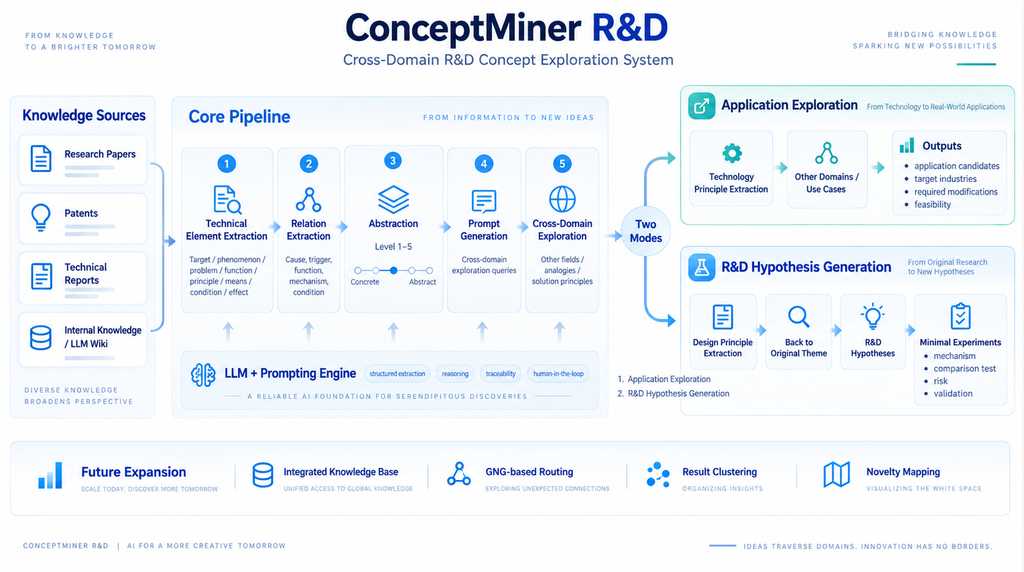
When technical documents—such as research papers or technical reports—are input, the system breaks down the technical elements described within them and abstracts—at multiple levels—the specific problems they address and the methods used to solve them. Based on this analysis, it automatically generates search prompts designed to explore fields outside the original domain and submits them to an LLM. From the resulting responses, the system generates R&D hypotheses for adopting cross-disciplinary methods to solve challenges within the company’s own technical domain, or ideas for applying the company’s technologies and technical elements to other fields. This process yields thousands of generated ideas.
By modeling the conceptual structure of this vast array of hypotheses and ideas using machine learning—thereby grouping similar ones together and visualizing their interrelationships—it becomes possible to plan research and development activities strategically and efficiently.
While a single research paper can yield thousands of hypotheses and ideas, systematically applying this process across your company’s entire body of technical documentation—while refining and distilling the resulting insights—will pave the way for formulating a corporate technology strategy. At Mindware Research Institute, we offer the expertise to construct conceptual structure models of your company’s internal technical documents, a service that can serve as your next step. To begin, we encourage you to take on the challenge of generating R&D hypotheses and ideas for cross-disciplinary applications from individual technical documents.
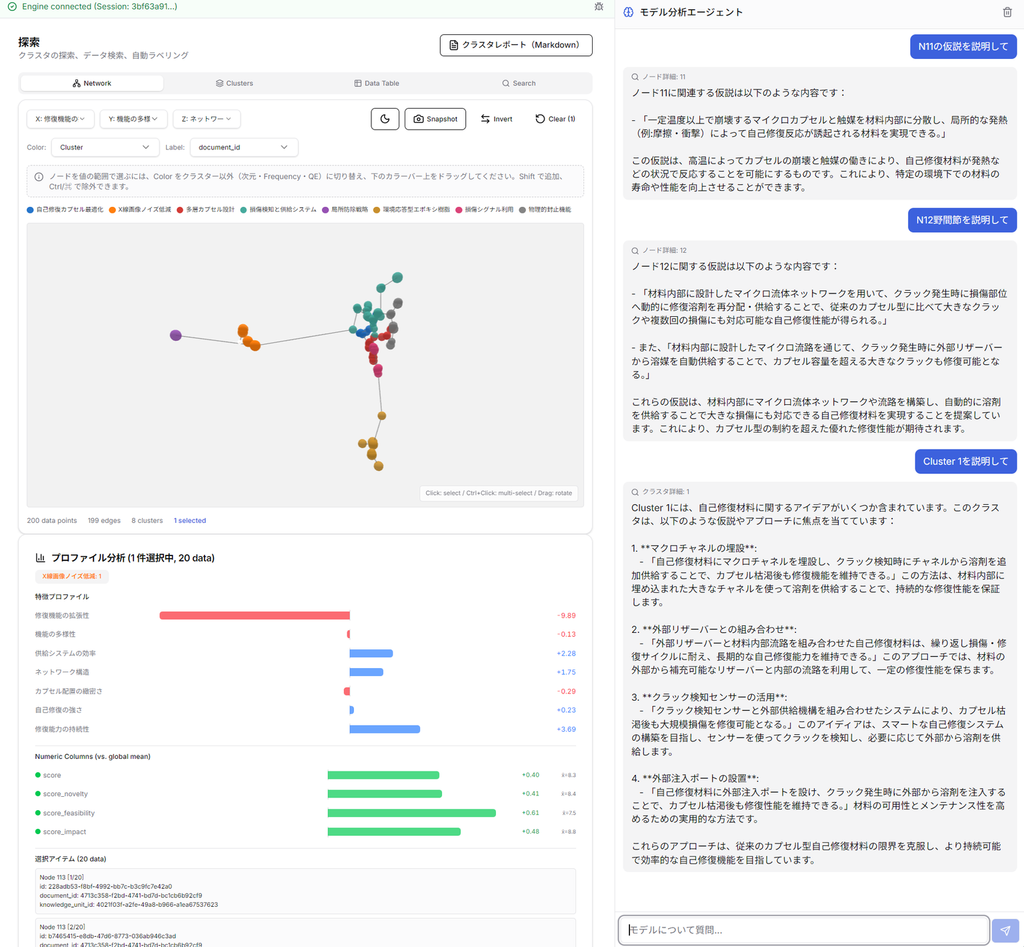 Hypotheses and ideas are evaluated based on a composite score, novelty, feasibility, and impact; AI then analyzes the conceptual structural model and provides advice.
Cross-Domain R&D Concept Exploration
If you are interested in testing this approach with real technical themes or internal technical documents, please contact Mindware Research Institute.
Contact Us / Request Project Information