
Is it really enough to simply “Gathering Information Exhaustively and Analyzing It Using the Correct Method”?
When exploring themes for research and development, concepts for new products, or ideas for new business ventures, a common approach involves listing a large number of keywords and then systematically and exhaustively investigating the details of each, following a prescribed format. Many organizations favor this method. But does it truly yield creative results? While it may appear rational at first glance, is it actually rational? To put it plainly: what this represents is procedural rationality.
Herbert Simon discussed the concepts of complete versus bounded rationality and procedural versus substantive rationality. If I may take the liberty of integrating them, the result is the following chart:
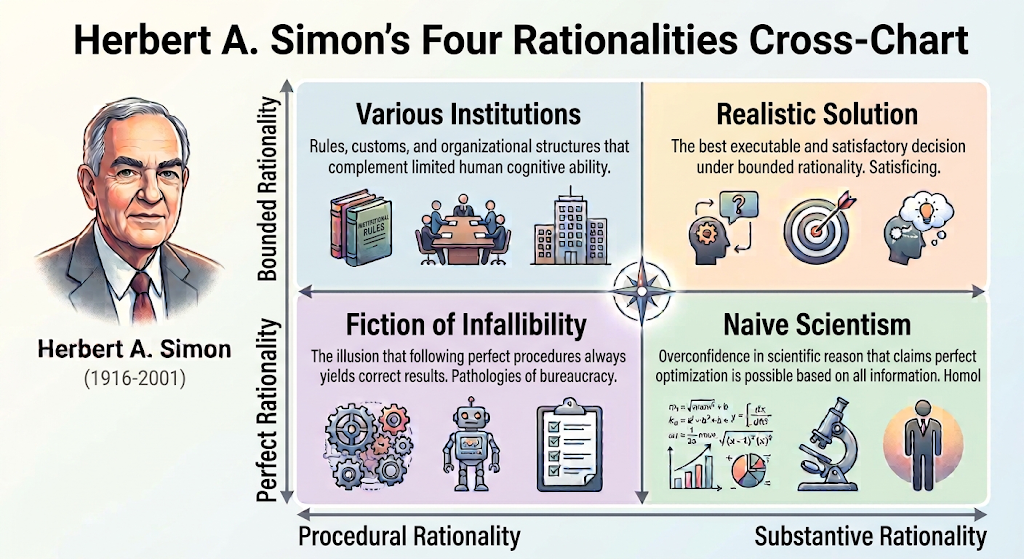
To engage effectively with the complexities of the real world, one must consider not only substantive rationality but also bounded rationality—for it is simply beyond human capacity to examine every piece of information in existence. In your own field, you have likely solved problems by synthesizing various technical elements. Similar challenges may exist in entirely different disciplines; conversely, other fields might employ approaches that, if adapted to your own, could yield unexpected breakthroughs. It is also possible that, in a field currently unknown to you, developments are underway that could profoundly impact your own area of expertise. You can surely see how difficult it is to detect such possibilities using conventional methods of gathering and analyzing information.
No matter how detailed the information you gather, if you limit your search to a narrow area, you are unlikely to find any real “treasures.” You need the courage to step outside your own area of expertise.What kind of treasure are you looking for? What are its characteristics? In short, that is what “concept research” entails. It is called “conceptual research” to distinguish it from “factual research.” The idea is to examine the concept—its extension and intension (the set and its shared characteristics)—before searching for the facts themselves.
Searching for things you don’t yet know
As for the origins of this concept, I actually devised it based on my past experience planning and managing corporate seminars at a publishing and seminar company. The business of such a company involves gathering attendees and collecting fees. The seminar topics themselves could be anything—information and communications, biotechnology, chemistry, energy, and so on. However, there were certain patterns common to seminars that attracted large audiences. In other words, rather than starting with a keyword and researching it, the approach was to start with a “winning pattern” and then find a topic that fit that model.
There is simply not enough time to build up specialized knowledge in every field from scratch. Rather than waiting to know everything before taking action, the only way to uncover the unknown in unfamiliar territory is to explore using abstracted, generalized structures, relationships, models, and patterns as guides. It is about setting aside specific technical details and focusing solely on the essential principles—asking, “What is actually happening here?” This mindset should also prove valuable when companies seek to break down the barriers of traditional specialized fields to explore new themes.
For instance, when looking for a marriage partner, you cannot—nor do you need to—consider every single person of the opposite sex in the world; you simply need to know what kind of person you would like to marry. The same applies when a company seeks out themes for research and development. The goal is to discover a “gem,” not to exhaustively scrutinize every piece of information. In many research settings, however, this inversion of ends and means occurs, making matters unnecessarily complicated. The root cause is a form of organizational rationality known as “procedural rationality.” While this is unavoidable when working within an organization, one should keep in mind that it can easily drift far away from “substantive rationality.”
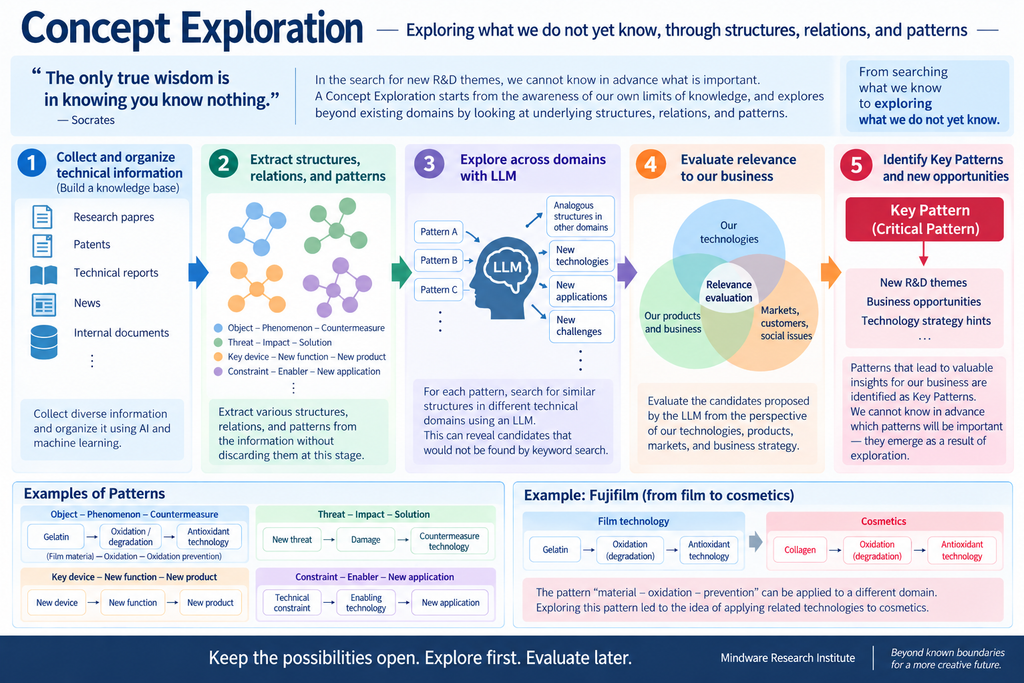
In the past—before the advent of LLMs—attempting to explain the concept of “concept research” often led to overly philosophical discussions. This was because explaining the process to others, with the assumption that the work would be done manually, required breaking down the underlying thought processes. Now, however, we have LLMs. Since the essence of an LLM lies in language itself, it is capable of manipulating concepts; by leveraging LLMs and machine learning, we have been able to transform this into a practical technical tool.
Let me give you an example of a simple experiment. Try asking an LLM questions such as, “Find applications for wedge engagement other than fastening,” or “In what situations might the principle of stably and uniformly dispersing fine particles over a long period be useful?” You should receive a wide range of answers. LLMs have been trained on technical information from all over the world. What is required is simply to formulate such questions based on your company’s own technological information.
Roadmap for the AI Industry and Enterprise Adoption
At Mindware Research Institute, we have dedicated ourselves to developing technologies that operationalize the thougt of “concept research.” Now, these technologies have been commercialized under the name “ConceptMiner R&D.” We refer to the underlying technical methodology as “Concept Exploration.” We are now pleased to offer a consulting program—the “Comprehensive R&D Asset Deployment Program“—designed to accelerate your company’s research and development efforts. The process involves: 1) conducting a detailed inventory of your company’s technical assets by breaking them down into granular technical components (based on research papers, technical reports, etc.); 2) exploring diverse, cross-disciplinary domains to generate a wide range of research themes, development hypotheses, and ideas for application in new fields; and 3) selecting and structuring these ideas from a strategic perspective to reconstruct your R&D roadmap. Please feel free to contact us for further information.