
From Purpose-Driven Data Generation to Analysis, Evaluation, and Decision-Making
Turning Data Generation into New Knowledge and Business Value
Advances in generative AI, statistical modeling, machine learning, and simulation technologies have made it possible to generate data that was previously difficult to obtain, including data representing conditions that do not yet exist in the real world.
However, generating large volumes of data is not an end in itself.
What matters is understanding why data should be generated, what kind of data is needed, what can be discovered from it, and how the results can support decisions and actions.
Organizations may have a wide range of objectives:
- Explore opportunities to apply existing technologies in new industries.
- Identify new R&D themes through the convergence of technologies from different fields.
- Explore consumer segments that may emerge five years from now.
- Investigate potential demand for products and services that do not yet exist.
- Generate synthetic datasets for machine learning when real-world data is insufficient.
- Simulate different environmental conditions, design alternatives, or operational scenarios.
- Compare business strategies under different assumptions and uncertainties.
No single data generation technology can address all these needs.
At Mindware Research Institute, our approach begins with the customer’s objectives and challenges. We aim to select and combine appropriate technologies to design an integrated process covering data generation, structuring, mining, and evaluation.
1. Our Fundamental Approach to Data Generation
Designing Methods Around Objectives
Traditional data analysis projects generally begin with existing datasets and investigate what knowledge can be extracted from them.
Data generation projects reverse this approach.
They begin by defining the knowledge to be discovered, the problems to be solved, the hypotheses to be evaluated, and the decisions to be supported.
The required data, its structure, generation methods, and evaluation criteria are then designed accordingly.
For example, when exploring cross-industry applications of existing technologies, the objective is not simply to collect large amounts of related technical information. Instead, we may design a process that generates new application hypotheses by examining technological functions, structures, and operating principles.
When exploring future consumer behavior, we may combine assumptions about demographics, lifestyles, values, and technology adoption to generate alternative consumer profiles and behavioral scenarios.
The starting point is not the technology itself, but the problem the customer wants to solve.
Integrating Qualitative and Quantitative Approaches
Data generation may involve qualitative information, such as hypotheses, concepts, ideas, and scenarios, as well as quantitative information, such as measurements, probabilities, performance indicators, and simulation results.
In many projects, the greatest value comes from combining the two.
For example, AI-generated product concepts may first be organized and evaluated qualitatively. Promising concepts can then be examined through quantitative market models, simulations, or experimental methods.
This integration connects creative exploration with systematic evaluation.
2. Our Data Generation Project Process
Step 1 — Define the Problem and Objectives
The first step is to clarify the project’s objectives and expected outcomes.
Broad requests such as “generate innovative ideas” or “predict future markets” are translated into specific exploration questions and evaluable goals.
Key considerations include:
- Business or research challenges to be addressed
- Target technologies, products, markets, or industries
- Scope and time horizon of the exploration
- Intended use of the generated data
- Information required for decision-making
- Criteria for evaluating project outcomes
Deliverables: Project objectives, exploration questions, and evaluation criteria.
Step 2 — Design the Data Generation Methodology
Appropriate information sources, generation technologies, and analytical methods are selected according to the project objectives.
Potential methods include:
Qualitative Data Generation
- LLM-based hypothesis and idea generation
- Cross-domain knowledge exploration and conceptual combination
- Analogical reasoning and knowledge transfer
- Future scenario generation
- Synthetic persona and behavioral scenario generation
- Agent-based dialogue and interaction simulation
Quantitative Data Generation
- Statistical and probability-based data generation
- Machine learning-based synthetic data generation
- Monte Carlo simulation
- Mathematical and physical simulation
- Design of Experiments (DOE) and computer experiments
- Probabilistic scenario generation using Bayesian networks
- Active learning and sequential experimentation
Multiple approaches may be combined to improve the relevance, diversity, and analytical value of the generated data.
Deliverables: Data generation methodology, generation conditions, and processing workflow.
Step 3 — Prepare Information Sources and Generation Conditions
Data generation requires appropriate inputs, assumptions, and conditions.
Depending on the project, these may include scientific publications, patents, technical documents, market information, internal company data, mathematical models, or hypothetical scenarios.
A critical requirement is to distinguish verified information from assumptions, interpretations, and AI-generated inferences.
We also examine potential biases and define relevant variables, constraints, exploration boundaries, and evaluation criteria.
Deliverables: Information sources, generation parameters, and data specifications.
Step 4 — Conduct Pilot Generation and Validate the Method
Before full-scale production, a limited pilot is conducted to evaluate the proposed approach.
For example, a project intended to generate 1,000 research hypotheses might begin with several dozen examples. These are assessed for relevance, diversity, duplication, supporting evidence, and other quality criteria.
For quantitative datasets, the evaluation may focus on statistical distributions, relationships between variables, model behavior, and consistency with known constraints.
Typical evaluation criteria include:
- Relevance to the project objectives
- Validity and traceability of supporting information
- Diversity and redundancy
- Novelty and feasibility
- Mathematical and statistical consistency
- Generation costs and processing efficiency
Based on the results, prompts, models, parameters, and generation procedures are refined.
Deliverables: Pilot dataset, quality assessment, and revised generation methodology.
Step 5 — Generate the Full Dataset
Once the methodology has been validated, data generation proceeds at the required scale.
Depending on the project, the output may range from dozens of detailed research hypotheses to thousands of technology application ideas or large-scale synthetic datasets.
Where appropriate, generated records may include:
- Unique identifiers and classification attributes
- Generated content and associated properties
- Sources, supporting evidence, and generation conditions
- Models and methods used
- Evaluation indicators and validation status
- Relationships to other hypotheses, technical elements, or scenarios
This structure enables the generated information to function as an analytical dataset rather than an unorganized collection of texts or numbers.
Deliverables: Generated dataset, metadata, and generation records.
Step 6 — Apply Data Mining and Structural Analysis
Large volumes of generated data cannot always be evaluated effectively through manual inspection.
Statistical analysis, clustering, dimensionality reduction, concept mapping, and graph analysis can be applied to reveal patterns, relationships, and underlying structures.
For example, a collection of R&D hypotheses can be mapped according to semantic similarity or technological relationships.
Concept maps may help identify clusters of related hypotheses, densely populated areas, and potentially underexplored regions.
Methods such as Self-Organizing Maps (SOM), Growing Neural Gas (GNG), and graph-based analysis can support this exploration.
For quantitative data, statistical modeling, sensitivity analysis, probability distributions, and other analytical methods may be applied.
Deliverables: Classification results, concept maps, statistical models, and analytical findings.
Step 7 — Evaluate Hypotheses and Extract Actionable Knowledge
The generated data and analytical results are evaluated to identify promising hypotheses, opportunities, or strategic alternatives.
For R&D applications, evaluation criteria may include technological novelty, feasibility, market potential, competitive advantage, and development risks.
For future market scenarios, the assessment may consider the plausibility of assumptions, potential impacts, uncertainties, and strategic implications.
Expert judgment can be supported by multicriteria decision analysis, probabilistic models, mathematical optimization, and other methods.
Additional rounds of data generation and analysis may be conducted to refine promising hypotheses or investigate newly identified questions.
Deliverables: Prioritized hypotheses or alternatives, evaluation results, and recommended areas for further investigation.
Step 8 — Deliver Results and Define Next Actions
Project results are provided in formats appropriate to the customer’s objectives and intended applications.
Possible deliverables include:
- Structured datasets in CSV, Excel, or JSON format
- Collections of hypotheses, ideas, and future scenarios
- Concept maps, clustering results, and graph structures
- Statistical models, probabilistic models, and simulation results
- Analytical and evaluation reports
- Research plans or experimental designs for further validation
Where appropriate, the results may also be provided in formats that enable customers to continue exploring and analyzing the generated data independently.
Deliverables: Final datasets, analytical outputs, and recommendations for subsequent validation or application.
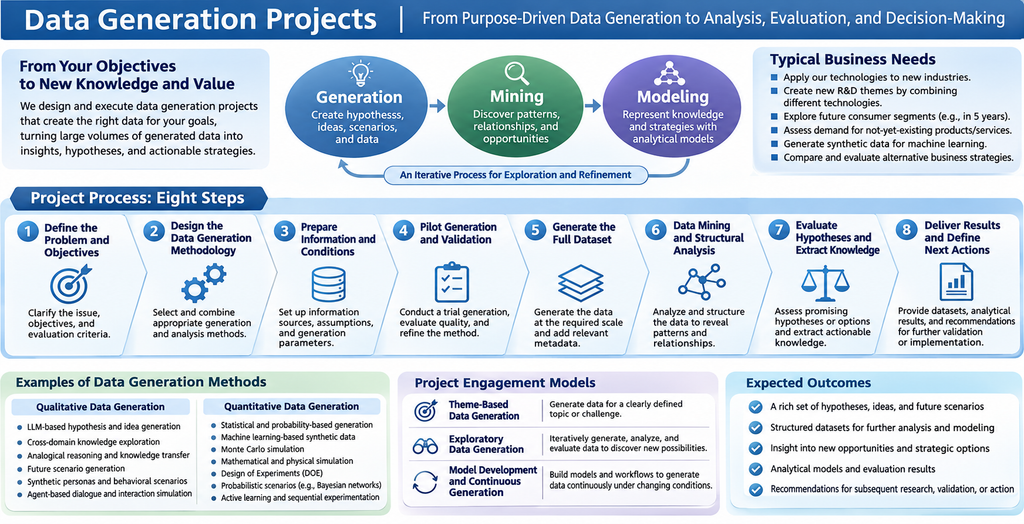
3. Project Engagement Models
Different objectives, budgets, and data requirements call for different project arrangements.
Theme-Based Data Generation
Data is generated for a clearly defined topic or challenge under agreed conditions.
Potential outputs include research hypotheses, technology application ideas, future scenarios, and synthetic datasets.
This model is suitable for projects with well-defined requirements and deliverables.
Exploratory Data Generation
Generation, analysis, and evaluation are performed iteratively to discover and investigate new possibilities.
The initial phase may generate a broad range of hypotheses. Promising areas are then selected for additional generation, analysis, and validation.
This approach is particularly suitable for R&D exploration and new business development, where the objectives may be clear but the specific opportunities cannot be determined in advance.
Model Development and Continuous Data Generation
Statistical models, probabilistic models, simulation systems, or AI-based generation workflows are developed to support repeated data generation under changing conditions.
Potential applications include periodic market scenario updates, comparisons of engineering design conditions, and the ongoing production of machine learning datasets.
4. Data Reliability, Confidentiality, and Intellectual Property
Data generation projects require careful consideration of quality, information security, and the appropriate use of generated results.
Reliability and Validation
Generated hypotheses, predictions, and scenarios must be distinguished from empirically established facts.
Depending on the intended application, validation may involve source verification, expert review, experiments, or statistical testing.
Confidentiality and Data Protection
When customer-provided information includes proprietary technologies, business information, or personal data, the processing environment and data handling procedures must be reviewed in advance.
Relevant considerations include AI service providers, data retention policies, access controls, and deletion procedures.
Intellectual Property and Usage Rights
AI-generated ideas do not automatically qualify as patentable inventions.
Intellectual property considerations may include novelty, inventive step, third-party rights, ownership of deliverables, and conditions governing their use.
These matters should be examined according to the nature of the project and applicable legal requirements.
Transparency and Reproducibility
Where feasible, information sources, assumptions, generation models, processing parameters, and evaluation criteria should be documented.
This helps customers understand the basis of the results and supports subsequent review, validation, or refinement.
5. The Mindware Research Institute Approach
Generation → Mining → Modeling
Mindware Research Institute has more than 25 years of experience working with statistical analysis, data mining, machine learning, Self-Organizing Maps, Bayesian networks, and related analytical technologies.
Building on this background, we are exploring approaches that integrate AI-based knowledge generation with mathematical and structural analysis.
Our approach emphasizes three interconnected processes.
Generation — Creating New Possibilities
Generate hypotheses, ideas, scenarios, numerical data, and other forms of information according to specific research or business objectives.
Mining — Discovering Meaningful Structures
Organize and analyze large collections of generated data to identify important patterns, relationships, and previously unrecognized opportunities.
Modeling — Representing Knowledge and Strategies
Represent discovered knowledge and selected strategies through conceptual, probabilistic, mathematical, or computational models that can support validation and decision-making.
By integrating these processes, our goal is to move beyond data production and help transform generated information into knowledge that can be evaluated and applied.
6. Discuss Your Data Generation Project
Data generation can support a wide range of applications in research and development, new business creation, marketing, strategic planning, product development, and other areas.
You do not need to have a specific technology or generation method in mind.
Start by telling us what you want to discover, predict, evaluate, or create.
We can explore suitable approaches based on your objectives, including:
- Data generation methods and required information
- Scope and scale of the generated datasets
- Analytical and evaluation techniques
- Validation requirements
- Deliverable formats and potential applications
- Technical feasibility and project implementation options
The appropriate approach will depend on the nature of the problem, the available information, and the resources required.
Beyond analyzing existing data, we aim to generate possibilities that do not yet exist—and explore their potential value.
Mindware Research Institute — Integrating Qualitative and Quantitative Thinking for the AI Era.