Knowledge creation activities in an era of accelerated innovation
We are currently in the midst of an unprecedented wave of technological innovation. AI is a prime example, but technological advancements are sweeping across various fields, not just AI. AI is also accelerating various other technological innovations. Furthermore, “innovation” is not limited to technology; it is poised to drastically change work, life, and the very nature of everything in the world.
When the world changes so dramatically, it’s virtually impossible for ordinary people to imagine what the world will be like afterward. Before the internet and smartphones became widespread, very few people could predict what daily life would be like. In this era, traditional methods of research are insufficient to keep up with the speed of change.
When past conventions no longer apply, people fall into a state of “cognitive rigidity” This is because they lack the “language” necessary to understand the change. Language is the vehicle for thought; without language, thought cannot exist. Therefore, when times change, we must acquire a new language. Companies that lead innovation, rather than simply following it, must be inventors of new languages.
The concept research that our company has been advocating since the 1990s is an activity of language exploration for becoming a creator of innovation. It can also be described as an activity of constructing new concepts. Since ancient times, creating new concepts has been the work of philosophers. Therefore, practicing concept research in the 1990s required a philosophical background. This is not very compatible with traditional corporate communication.
This can also be explained from the perspective of E.M. Rogers’ theory of innovation diffusion. Innovators have a unique sensibility that is isolated from the general public, making communication difficult. Ideally, the company’s top management would be innovators, but in reality, things aren’t always that convenient. It’s understandable that innovative ideas are often not adopted in big campanies. It’s impossible, and shouldn’t be, to bring in an innovator from somewhere and replace the top management.
So, is there no solution? Yes, there is. In short, the solution is to implement the KJ method using AI. There are pros and cons to the traditional KJ method. It’s criticized for being arbitrary, being dominated by the relationships between participants, and being inefficient. Frankly speaking, even if a group of ordinary people practice the KJ method, they can’t compete with a single genius. However, if the KJ method had one advantage, it was its ability to allow for the sharing of ideas within an organization.
If ordinary people have time to rack their brains over something they don’t have, they should fearlessly utilize AI. AI can process information in a hyper-multidimensional space imperceptible to humans, in ways that transcend the limitations of human language. It already possesses genius-level potential. However, AI lacks motivation. Humans need to guide it. But traditional chat interfaces have limitations in accurately conveying human intentions to AI, or in accurately understanding AI intentions. There is a risk of misunderstandings and being misled by AI.
Many reports indicate that AI is overly positive towards users. makes it difficult for users to correct their mistakes!
Therefore, Mindware Research Institute considered developing a human-AI thinking interface.
Self-organization of disparate information
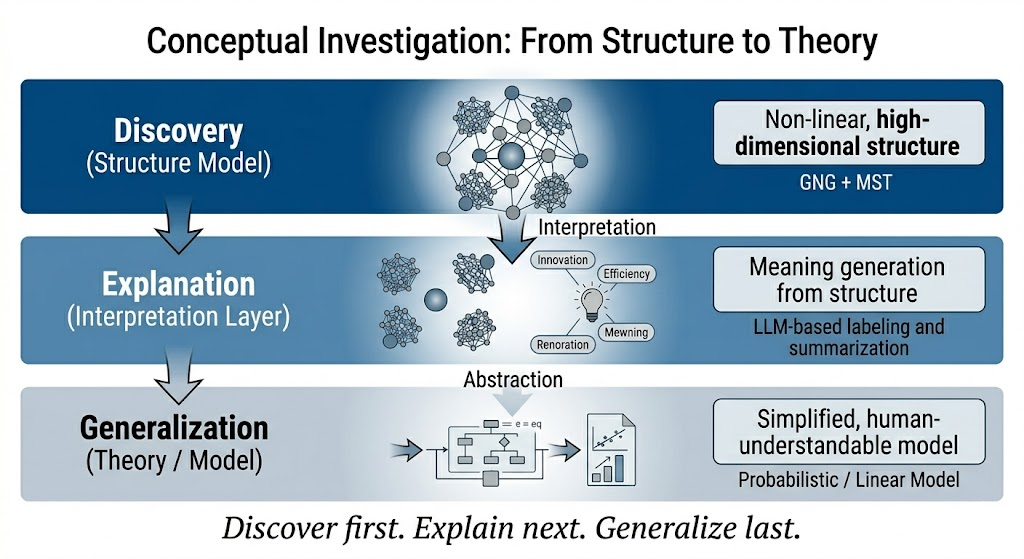
Mindware Research Institute has developed a technology called ConceptMiner to enable humans and AI to share thoughts. The key elements are embedding vectors, which are used as the foundation for many AI applications such as RAG (Retrieval-Augmented Generation), and growing neural gas, which belongs to the same self-organizing neural network as SOM (Self-Organizing Map). While there are many other elemental technologies, the general principle is that this allows for the classification of qualitative information by similarity, similar to the KJ method, and the construction of a graph structure.
ThinkNavi is an application layer that makes ConceptMiner usable even for those without data science knowledge. It’s like a showroom showcasing some of the capabilities of ConceptMiner. ThinkNavi bridges the gap between analysis and decision-making.
- Idea generation and organization
- Market structure visualization
- Competitive positioning analysis
- New product concept generation
- Exploration of R&D themes
- Automatic generation of strategic reports
Research is no longer about “collecting and analyzing factual information,” but rather about “exploring possibilities and generating new concepts.”We support the following people who should be at the forefront of innovation:
- Strategy consultant
- Marketing leader
- R&D leader
- Executive, etc.