Mindware Research Institute is developing a next-generation AI knowledge platform that helps enterprises not only search and summarize information, but also discover conceptual structures, hidden relationships, contradictions, knowledge gaps, and associative trails across large bodies of knowledge.
At the core of our technology is ConceptMiner, our proprietary conceptual structure modeling engine. ConceptMiner transforms documents, meeting transcripts, customer feedback, research materials, and other qualitative information into self-organizing conceptual networks.
We originally developed this approach as Self-Organizing RAG+ — an extension beyond conventional retrieval-augmented generation. While traditional RAG retrieves relevant document fragments at query time, Self-Organizing RAG+ reorganizes knowledge itself into conceptual maps that can be explored, interpreted, and reused.
We are now evolving this technology into Self-Organizing Wiki.
Self-Organizing Wiki builds on the emerging idea of LLM Wiki, but extends it with ConceptMiner’s self-organizing conceptual modeling technology.
Why Andrej Karpathy’s LLM Wiki Matters
In AI, major shifts are often shaped not only by new technologies, but also by the concepts that help people understand them.
Andrej Karpathy is one of the most influential thinkers in modern AI. He was a founding member of OpenAI and later served as Director of AI at Tesla, where he led the computer vision team for Autopilot. His public profile describes him as an AI researcher and educator, a former founding member of OpenAI, and a former Director of AI at Tesla.
Karpathy has repeatedly introduced concepts that helped the AI community understand technological shifts. One important example is Software 2.0, his framing of neural networks as a fundamental shift in how software is developed, rather than simply another machine learning tool.
His latest proposal, LLM Wiki, is similarly important. In his public gist, Karpathy describes an LLM Wiki as “a directory of LLM-generated markdown files,” including summaries, entity pages, concept pages, comparisons, overviews, and syntheses. In this model, the LLM creates and updates the wiki, maintains cross-references, and keeps the knowledge base consistent as new sources arrive.
This changes the framing of enterprise AI.
Instead of asking an LLM to retrieve raw document chunks every time a question is asked, LLM Wiki suggests that the LLM should compile knowledge into a persistent, readable, maintainable knowledge base.
We believe this is a major turning point.
But we also believe LLM Wiki is only the beginning.
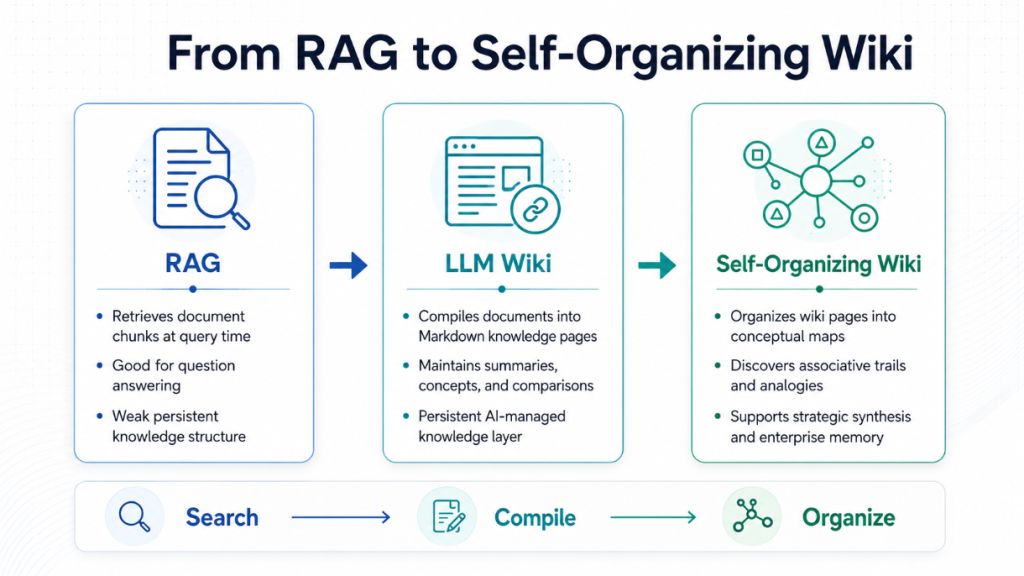
From RAG to LLM Wiki to Self-Organizing Wiki
The first wave of enterprise generative AI was largely driven by chatbots and RAG.
RAG made it possible to connect LLMs to enterprise documents.
However, RAG is mostly a retrieval mechanism. It searches for relevant passages and generates answers at query time.
LLM Wiki takes a different step.
It turns documents into a persistent AI-maintained knowledge base.
Self-Organizing Wiki goes further.
It transforms that wiki into a self-organizing conceptual map.
RAG
= retrieves documents

LLM Wiki
= compiles knowledge into a persistent wiki

Self-Organizing Wiki
= organizes that wiki into conceptual maps and associative trails
This is the strategic shift we are building around.
The Enterprise Knowledge Problem
Enterprises do not simply need more document search.
They need systems that can help them understand how knowledge is structured, how ideas are connected, where contradictions exist, and how insights in one domain can be transferred to another.
Most enterprise AI systems still struggle with the following problems:
- Documents can be searched, but the overall knowledge structure remains invisible.
- Summaries can be generated, but relationships between concepts are often unclear.
- Knowledge is accumulated, but not transformed into reusable organizational memory.
- Different departments, projects, markets, and customer issues remain disconnected.
- RAG systems generate answers, but do not continuously grow a structured knowledge base.
- AI-generated wikis are useful, but difficult to maintain in dynamic enterprise environments without structural analysis and validation.
Self-Organizing Wiki is designed to address this gap.
Why a Naive LLM Wiki Is Not Enough for Enterprises
LLM Wiki is a powerful new pattern, but a simple Markdown wiki alone is not enough for many enterprise use cases.
Enterprise knowledge changes frequently.
Access rights matter.
Source traceability matters.
Auditability matters.
Different documents may conflict with each other.
Some knowledge must be treated as official, while other knowledge should be treated as interpretation, hypothesis, or analysis.
For this reason, we do not treat the wiki as the final source of truth.
Instead, Self-Organizing Wiki treats the wiki as an AI-generated knowledge layer built on top of original sources.
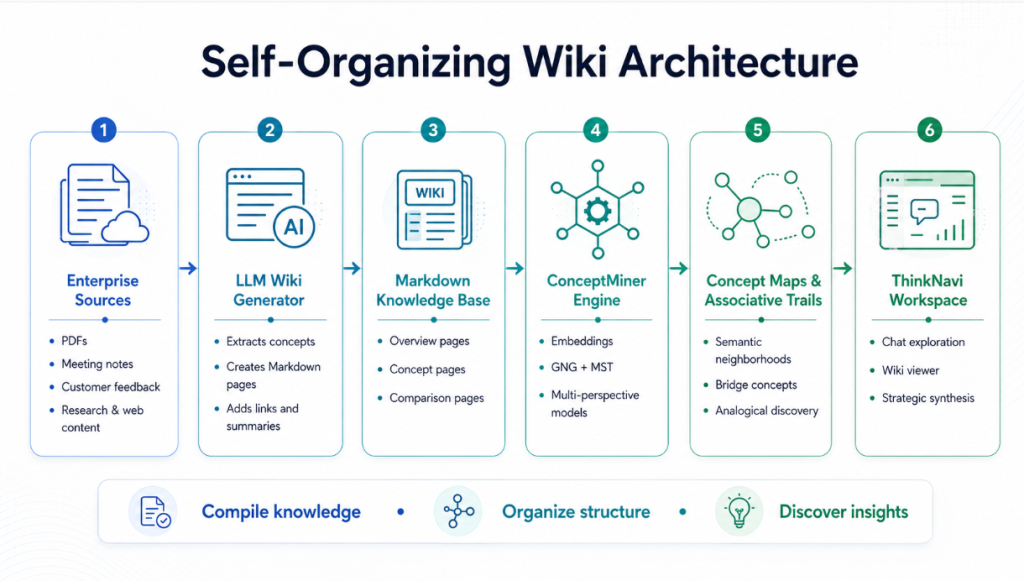
Original enterprise sources
= source of truth

LLM Wiki layer
= AI-generated structured knowledge

ConceptMiner layer
= self-organizing conceptual map

ThinkNavi interface
= exploration, dialogue, synthesis, and decision support
This allows enterprises to benefit from LLM Wiki-style knowledge compilation while preserving the distinction between original documents and AI-generated interpretation.
What ConceptMiner Adds
ConceptMiner is the engine that turns an AI-generated wiki into an explorable conceptual structure.
It takes text chunks, wiki pages, and generated conceptual descriptions, converts them into embeddings, and organizes them using a GNG+MST-based conceptual structure network.
The result is not just a list of search results.
It is a conceptual terrain.
ConceptMiner helps identify:
- concept clusters
- semantic neighborhoods
- bridge concepts
- knowledge gaps
- duplicated or fragmented concepts
- structural changes over time
- hidden relationships between distant topics
- areas where new hypotheses may emerge
In Self-Organizing Wiki, Markdown pages remain human-readable knowledge artifacts.
ConceptMiner adds a machine-discoverable structure behind them.
Multi-Perspective Models for Associative Discovery
A key feature of Self-Organizing Wiki is that it does not rely on a single semantic space.
From the same original document or wiki page, the system can generate multiple representations, such as:
- Trigger / Situation / Motive
- Logical Structure
- Implication / Lesson
Each representation can be embedded and organized into a separate self-organizing model.
Original document
  ├─ Trigger model
  ├─ Structure model
  └─ Implication model
This enables a new kind of associative traversal.
A user may first match a current situation in the Trigger model and arrive at Document A.
Then the system can locate the same Document A in the Structure model.
There, different documents may appear nearby — not because they discuss the same topic, but because they share a similar logical structure.
This makes it possible to discover analogies across apparently unrelated domains.
Self-Organizing Wiki does not only retrieve similar topics.
It helps discover similar structures.
From Knowledge Base to Enterprise Associative Memory
We believe enterprise AI will move beyond chatbots and document search.
The next stage is Enterprise Associative Memory.
Enterprise knowledge is not merely a collection of files.
It includes documents, meetings, customer feedback, decisions, failures, lessons, tacit knowledge, market observations, and strategic hypotheses.
Self-Organizing Wiki is designed to transform these materials into:
AI-maintained Wiki
  ↓
Self-organizing concept maps
  ↓
Associative trails
  ↓
Enterprise Associative Memory
This allows organizations to reuse their knowledge not only for answering questions, but also for strategy, innovation, customer understanding, product development, organizational learning, and AI governance.
Initial Use Cases
1. AI Knowledge Wiki Audit
We help companies convert a snapshot of their documents, meeting transcripts, sales materials, customer feedback, and research reports into an AI-generated wiki and conceptual map.
Typical deliverables include:
- AI-generated wiki
- concept map
- key themes
- knowledge gaps
- contradictions
- duplicated concepts
- strategic opportunities
- associative trails
This is the most practical initial use case because it avoids the complexity of real-time enterprise wiki maintenance while still delivering immediate insight.
2. Customer Feedback and VOC Intelligence
Customer feedback can be transformed into a structured wiki and conceptual model.
This helps companies understand:
- customer pain points
- unmet needs
- emotional drivers
- product improvement opportunities
- competing value propositions
- hidden segments
- strategic implications
3. Consultant Intelligence Workspace
Self-Organizing Wiki can support consultants, business advisors, DX consultants, market researchers, and organizational development professionals.
They can use it to quickly structure client materials, discover important themes, and generate stronger hypotheses for proposals, workshops, and reports.
4. Enterprise Knowledge and Meeting Intelligence
Companies can use Self-Organizing Wiki to structure internal documents, meeting records, project materials, FAQs, and past decisions into a long-term organizational memory layer.
5. Strategic Research and Competitive Intelligence
Market reports, competitor information, industry news, academic papers, and patent summaries can be compiled into an AI-maintained wiki and mapped into conceptual structures for strategic exploration.
Go-to-Market Strategy
Our initial market entry is not a generic chatbot product.
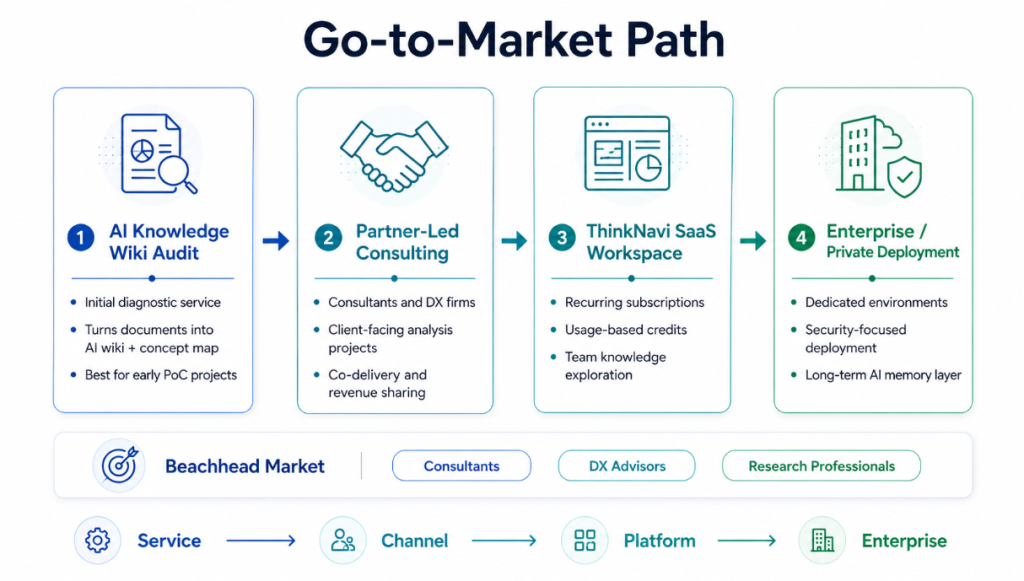
We are starting with AI Knowledge Wiki Audit, a diagnostic service that turns enterprise knowledge into an AI-generated wiki and self-organizing concept map.
This service can be delivered directly to companies or through professional partners, including:
- management consultants
- SME advisors
- DX and AI consultants
- market research firms
- organizational development consultants
- customer experience consultants
- business development advisors
This channel is important because these professionals already work with the kinds of qualitative materials that Self-Organizing Wiki can transform.
From there, we plan to expand into:
Diagnostic service
  ↓
Partner-led consulting package
  ↓
ThinkNavi SaaS workspace
  ↓
Enterprise / private deployment
Business Model
Phase 1: Diagnostic Services
AI Knowledge Wiki Audit
A project-based service for companies that want to understand the structure of their documents, customer feedback, meetings, or research materials.
Possible pricing range:
Small PoC:        ¥300,000 – ¥1,000,000
Enterprise PoC:  ¥1,000,000 – ¥5,000,000
Phase 2: Partner Channel
We will package the service for consultants, DX firms, and research professionals who can introduce Self-Organizing Wiki to their clients.
Revenue models may include:
- project fees
- partner licenses
- usage-based credits
- revenue sharing
- white-label or co-branded services
Phase 3: SaaS Workspace
Self-Organizing Wiki will become part of the ThinkNavi workspace.
Potential SaaS revenue streams include:
- monthly subscription
- usage-based billing
- wiki generation credits
- ConceptMiner model generation credits
- advanced analysis features
- team workspaces
Phase 4: Enterprise Deployment
For larger enterprises, we plan to support dedicated environments, private cloud, and potentially on-premise deployments, depending on security and compliance requirements.
Technology Foundation
Self-Organizing Wiki is not starting from zero.
It builds on our existing development work around:
- ThinkNavi
- ConceptMiner
- Self-Organizing RAG+
- GNG+MST conceptual structure modeling
- LLM-based concept labeling
- multi-perspective chunk generation
- associative traversal across multiple models
- strategic synthesis through AI dialogue
The emergence of LLM Wiki gives us a clearer market language for explaining what we have already been developing.
Our positioning is simple:
LLM Wiki stores and maintains knowledge.
Self-Organizing Wiki discovers its structure and associative potential.
Development Roadmap
0–3 Months
- LLM Wiki Generator MVP
- Markdown wiki output
- Wiki-to-ConceptMiner pipeline
- Basic wiki viewer
- Concept map integration
- AI Knowledge Wiki Audit package
- Investor and partner demo
3–6 Months
- Multi-perspective models
- Trigger
- Structure
- Implication
- Associative Trails
- Consultant partner pilots
- First paid PoC projects
- English-language investor and partner outreach
6–12 Months
- ThinkNavi SaaS packaging
- Partner dashboard
- Enterprise pilot
- Source traceability and audit features
- Delta analysis between knowledge snapshots
- IP and white paper development
Investment and Partnership Opportunities
Mindware Research Institute is seeking strategic support to accelerate the development and commercialization of Self-Organizing Wiki, ConceptMiner, and ThinkNavi.
We are open to discussions around:
- angel investment
- strategic investment
- capital and business alliances
- joint PoC projects
- partnerships with AI / DX consulting firms
- partnerships with management consultants and research firms
- enterprise pilot projects
- international expansion support
- technology licensing or co-development
We are not only looking for capital.
We are looking for partners who can help us connect this technology to real enterprise use cases, customer channels, and global AI markets.
Message to Investors
Generative AI is moving beyond chat.
The first wave connected LLMs to documents.
The next wave will organize enterprise knowledge into persistent, structured, and reusable intelligence layers.
RAG made enterprise documents searchable.
LLM Wiki makes enterprise knowledge compilable.
Self-Organizing Wiki makes enterprise knowledge structurally explorable and associatively reusable.
Mindware Research Institute is building the conceptual structure layer for this next phase of enterprise AI.
We invite investors, strategic partners, and forward-looking enterprises to join us in building the Enterprise Associative Memory layer for the AI era.
Contact
If you are interested in investment, partnership, PoC projects, or strategic collaboration around Self-Organizing Wiki, ConceptMiner, or ThinkNavi, please contact us through the form below.
Possible discussion topics:
- investment or strategic partnership
- joint enterprise PoC
- AI Knowledge Wiki Audit
- consultant partner program
- integration with AI / DX consulting services
- enterprise deployment
- international expansion
- technology demonstration
Contact us for investment or partnership opportunities.
The Vision of Mindware Research Institute