— The Universe as a Causal Network and Its Philosophical Implications —
Abstract
This article aims to provide an integrated perspective on the Many-Worlds Interpretation (MWI) of quantum mechanics, relativity theory, and causal set theory, using Bayesian networks (BNs) as a common language of causal modeling. When the physical universe is regarded as a gigantic network endowed with causal structure and probabilistic (or quantum) dynamics, these three theoretical frameworks can be seen as closely related under a unified conceptual scheme.
First, we show that the branching structure of MWI can be formalized as a set of paths in a Bayesian network. Next, we discuss how the causal structure defined by light cones in relativity and the discrete spacetime of causal set theory can be made consistent. Finally, we propose a philosophical view of “the universe as a gigantic Bayesian network” and explore structural similarities between the causal structure of the physical universe and the semantic networks that appear in cognitive science and AI models (e.g., ConceptMiner).
This article was written by ChatGPT based on the ideas of Kunihiro Tada. Enjoy it as scientific fiction.
1. Introduction
Traditional descriptions of the structure of the universe in physics are typically given in terms of continuous spacetime manifolds and quantum state vectors. In recent decades, however, approaches that regard causal structure as the primary constituent of the universe have gained increasing attention.
In particular, the following three domains, despite their different formalisms, share a common conceptual foundation: the network of causal relations.
- Many-Worlds Interpretation (MWI): branching structure induced by quantum measurements;
- Relativity theory: causal constraints imposed by light cones;
- Causal set theory: a model of spacetime constructed from discrete events and their causal order.
On the other hand, Bayesian networks (BNs), originally developed for statistical inference and machine learning, are built upon directed acyclic graphs (DAGs) that represent causal dependencies among random variables. The structural core of BNs is strikingly similar to the causal structures that appear in the above physical theories.
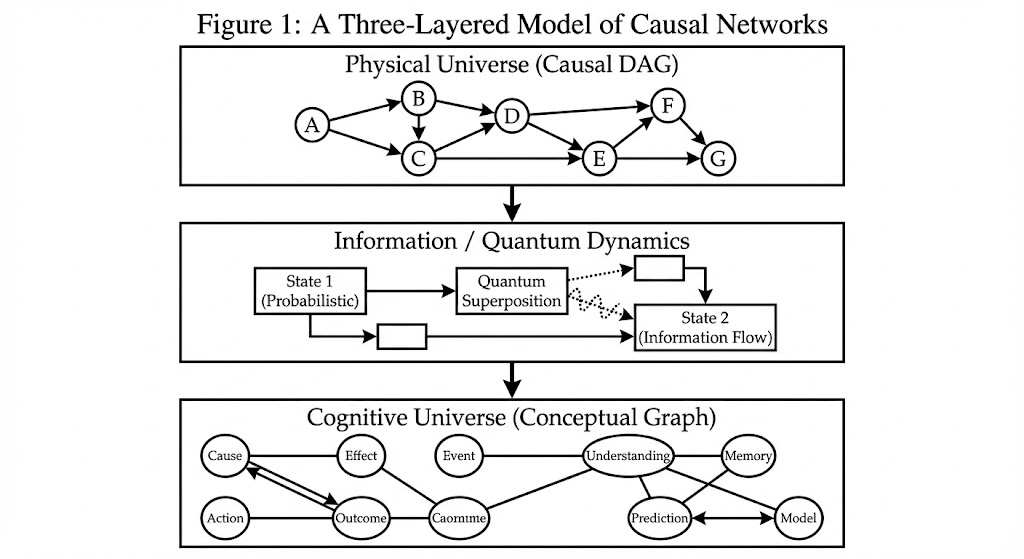
In this article, we attempt to move beyond mere metaphor and systematically articulate a unified perspective in which the universe itself is modeled as a gigantic causal network. Figure 1 depicts the three-layer structure that we shall repeatedly refer to: the physical universe, information/quantum dynamics, and the cognitive universe.
2. Bayesian Networks and the Basics of Causal Inference
A Bayesian network is a causal model defined by a set of random variables and a directed acyclic graph (DAG). Nodes represent variables, and directed edges represent causal dependencies. The joint probability distribution factorizes according to the graph:P(X1,…,Xn)=i∏P(Xi∣Pa(Xi)),
where Pa(Xi) denotes the set of parent nodes of Xi.
A crucial property of BNs is that they encode, in a single distribution, an ensemble of all possible worlds (sample paths). A single observed world corresponds to one particular sample, but the model as such encompasses all unrealized possibilities as well.
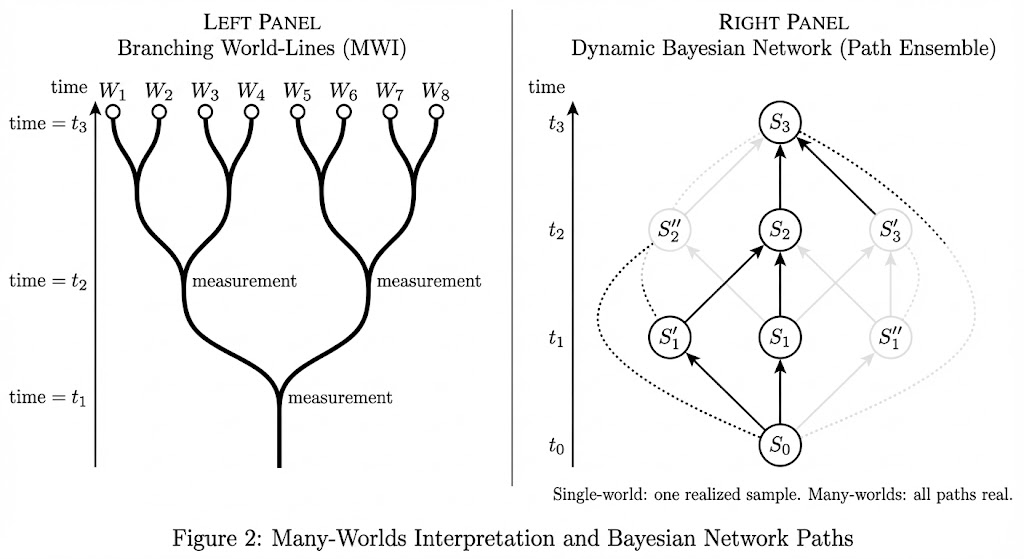
This “ensemble of possibilities” is deeply analogous to the superposition of quantum states and the branching structure emphasized in MWI. Figure 2 provides a conceptual comparison between BN path ensembles and branching world-lines.
3. Many-Worlds Interpretation and a BN-like Formalization
3.1 Branching Worlds in MWI
According to the Many-Worlds Interpretation, quantum measurements do not collapse the wavefunction into a single outcome. Rather,
all possible outcomes are realized, and the world branches accordingly.
The key idea is that these branches are not merely hypothetical possibilities; each branch is equally real. A single “history of the universe” corresponds to one branch (one world-line), and MWI regards the totality of such histories as the multiverse.
3.2 Dynamic Bayesian Networks for Temporal Evolution
Let St denote the state of the universe at discrete time t. Then the temporal structure can be represented as a Dynamic Bayesian Network:S0→S1→S2→….
Each St corresponds to the global state of the universe (a classical configuration or a quantum state).
From a classical BN viewpoint, P(St+1∣St) defines a stochastic transition, and a single history is generated probabilistically. From an MWI perspective, however, unitary evolution is fundamentally deterministic, and measurement induces branching into multiple coexisting histories.
3.3 The Multiverse as a Set of Paths
The joint distribution encoded by a BN defines an ensemble of sample paths, and this ensemble can naturally be interpreted as a space of multiple histories. Comparing classical BN and MWI:
- Classical BN interpretation:
The model encodes all paths as possible, but only one is realized in actuality.
- MWI interpretation:
All paths are equally real, and observers are embedded in one of them.
Thus, the difference lies primarily in the ontological status of the paths, not in the abstract structure. Figure 2 illustrates this correspondence: the branching tree of world-lines on the left, and the path ensemble of a Dynamic BN on the right.
4. Causal Structure in Relativity and Causal Set Theory
4.1 Causal Structure in Relativity
In special and general relativity, each event in spacetime is associated with a light cone, which constrains causal influence:
- Future light cone: set of events that can be influenced by a given event;
- Past light cone: set of events that can influence a given event.
This causal structure can be formalized as a partial order:ei≺ej⟺ei lies in the causal past of ej.
Unlike Newtonian absolute time, relativity denies a global notion of simultaneity shared by all observers. However, because of the finite speed of light, causal order itself is invariant.
4.2 Causal Set Theory: Discrete Spacetime
Causal set theory proposes that
spacetime = (a set of events C) + (a causal order ≺),
where the pair (C,≺) constitutes a causal set. Distances and time intervals are regarded as emergent, reconstructed (in a coarse-grained sense) from the density and structure of these events.(C,≺)with≺ transitive, antisymmetric, and irreflexive.
From this perspective, smooth spacetime manifolds are macroscopic approximations of an underlying discrete causal structure.
4.3 Correspondence Between Relativity and Causal Sets
Figure 3 juxtaposes a Minkowski diagram with light cones (left) and its discretized counterpart as a causal set (right). The causal structure defined by light cones in continuous spacetime corresponds closely to the partial order in a causal set.
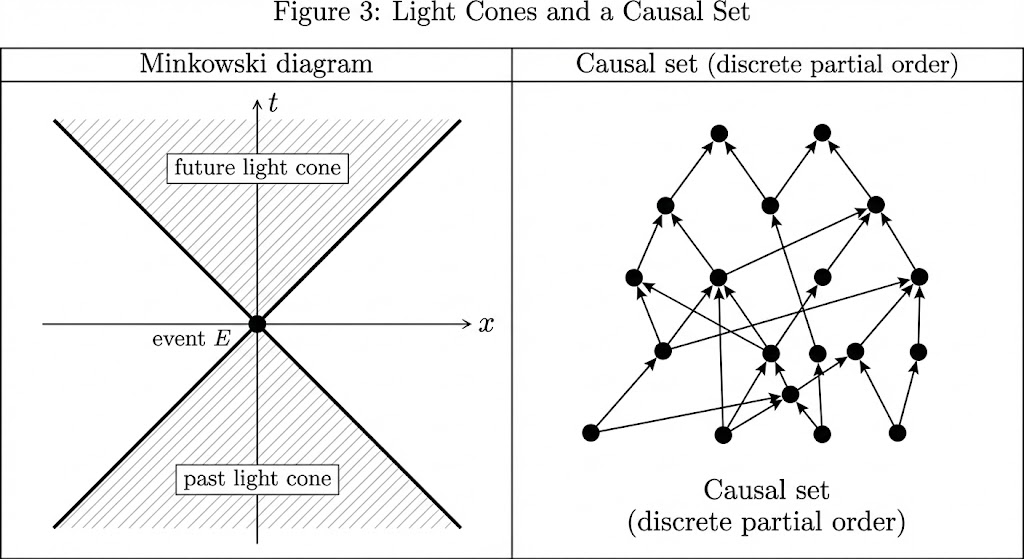
Thus, continuous spacetime can be viewed as a large-scale approximation of a deeper causal set, and the directed graph of the causal set can be seen as a discrete representation of relativistic causal constraints.
5. A Unified Model: The Universe as a Gigantic Bayesian Network
Bringing these threads together, we can outline a unified model as follows.
5.1 Structural Level: The Universe as a Giant Causal DAG
- Nodes: physical events (particle interactions, measurements, scatterings, etc.);
- Edges: causal relations (reachability within light cones).
At this structural level, the universe is essentially a gigantic causal set, and its graph representation is isomorphic to the DAG underlying a Bayesian network.
5.2 Dynamical Level: Propagation of Probabilities / Amplitudes
On top of this causal DAG, physical quantities are defined as (classical or quantum) variables:
- Classical regime: P(Xi∣Pa(Xi)), as in a standard BN;
- Quantum regime: unitary transformations and projective measurements represented as quantum channels assigned to edges or nodes.
The universe can then be described as a process of updating information, probabilities, or quantum amplitudes along the causal DAG. This is closely related to quantum causal models or quantum Bayesian networks, which generalize BN ideas to the quantum domain.
5.3 Interpretational Level: Single-World, Many-Worlds, and Informational Views
Given the same structural and dynamical framework, multiple interpretations are possible:
- Single-world interpretation (classical realism)
Only one path on the DAG is regarded as actual.
- Many-worlds interpretation (MWI)
All paths on the DAG are equally real; observers are situated on particular branches.
- Information-theoretic interpretation (e.g., QBism)
Probabilities represent an agent’s degrees of belief, and the DAG is a normative structure for rational inference, rather than a literal ontology of the world.
In this sense, structure and dynamics are shared, while interpretations differ in their claims about what is ontologically real.
6. Philosophical Consequences and Structural Similarity to the Cognitive Universe
6.1 Causal Structure of the External World and the Internal (Cognitive) World
The causal network of the physical universe and the network structures found in human cognition and AI systems exhibit notable structural similarities:
- Physical universe: causal sets plus quantum/probabilistic dynamics;
- Cognitive universe: nodes representing concepts, memories, or experiences, linked by causal and associative relations;
- AI models (SOM, GNG, BNs, knowledge graphs, etc.): discrete representations of data spaces with similarity or causal links.
This structural analogy suggests that tools like ConceptMiner can serve as devices for visualizing and manipulating the causal/semantic network of the cognitive universe.
6.2 A Reversal: Does the Universe “Perform Inference”?
Typically, BNs are viewed as tools for observers to infer properties of the world. But if causal structure is fundamental, we can adopt a reverse perspective:
The universe itself may be regarded as a gigantic process of “updating” its own state along a causal network.
This resonates with Wheeler’s “It from bit” idea and with predictive processing theories in cognitive science, which portray the brain/mind as a prediction machine.
6.3 Implications for the Human–AI Relationship
If AI systems model and intervene in the causal structure of the cognitive universe, then:
- AI mentors,
- AI governance in organizations, and
- ConceptMiner-like tools for conceptual exploration and innovation
can all be reframed as problems of controlling and navigating layered causal networks—those of the physical world, social systems, and human cognition.
7. Conclusion
We have argued that the Many-Worlds Interpretation, relativity theory, and causal set theory—seemingly disparate theoretical frameworks—can all be understood within a single abstract structure: the universe as a causal network.
- The branching structure of MWI can be formalized as the ensemble of paths in a Bayesian network.
- The light-cone structure of relativity corresponds to a partial order over events, and causal set theory discretizes this structure.
- The dynamics of the universe can be represented as the propagation of probabilities or amplitudes along a causal DAG.
- Human cognition and AI systems also instantiate causal and semantic networks, exhibiting a self-similar relationship to the causal structure of the physical universe.
Adopting this perspective allows us to reinterpret the universe itself as a vast inferential or information-updating process carried out on a causal network, suggesting a unifying framework that bridges physics, cognitive science, information theory, and AI.