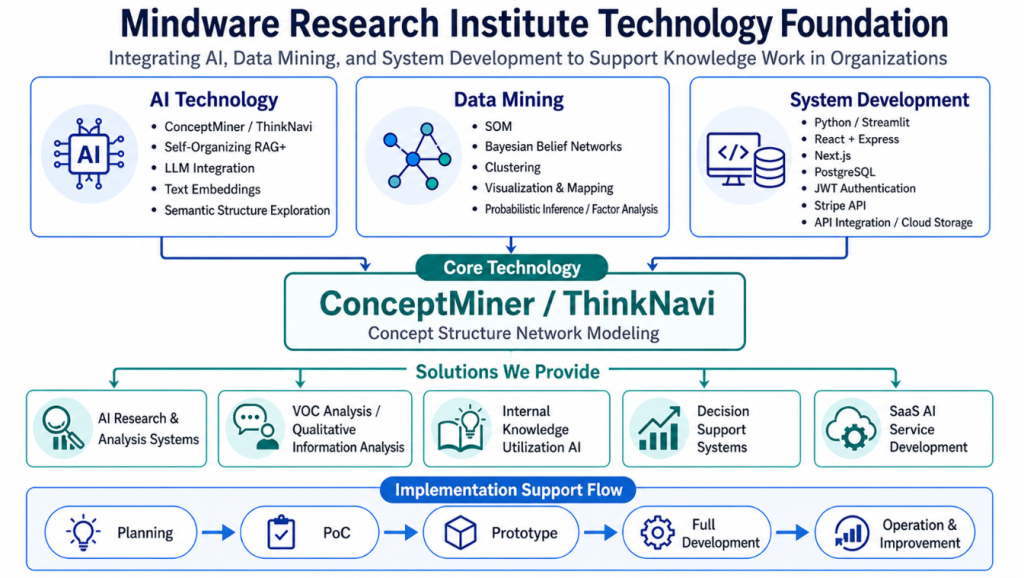
We integrate AI, data mining, and system development to support companies’ intellectual operations.
Mindware Research Institute is a technology development company that combines AI, data mining, and system development to support companies in their research, analysis, decision-making, and operational efficiency improvements.
We don’t simply develop AI chatbots or business automation tools.
We structure large amounts of text, customer feedback, internal documents, survey data, and mixed numerical and categorical data, building systems that allow for exploration, analysis, and utilization in a human-readable format.
At the core of our operations are our proprietary conceptual structure network modeling technology, ConceptMiner, and the thinking support and research support application, ThinkNavi, which utilizes it.
Based on these technologies, we plan and develop enterprise-向け AI systems, qualitative information analysis systems, data mining support tools, and SaaS-type business applications.
1. AI Technology
Conceptual structure network modeling using ConceptMiner / ThinkNavi
The core of Mindware Research Institute’s AI technology is a conceptual structure network model for visualizing and exploring the semantic structure behind text and documents.
Traditional AI applications primarily focused on asking questions to LLMs (Large Language Models) and obtaining answers.
However, companies possess a vast amount of unstructured text, including meeting minutes, customer testimonials, sales records, product reviews, research reports, technical documents, and research materials.
Simply searching through this text makes it difficult to grasp the overall picture, potential issues, and hidden relationships.
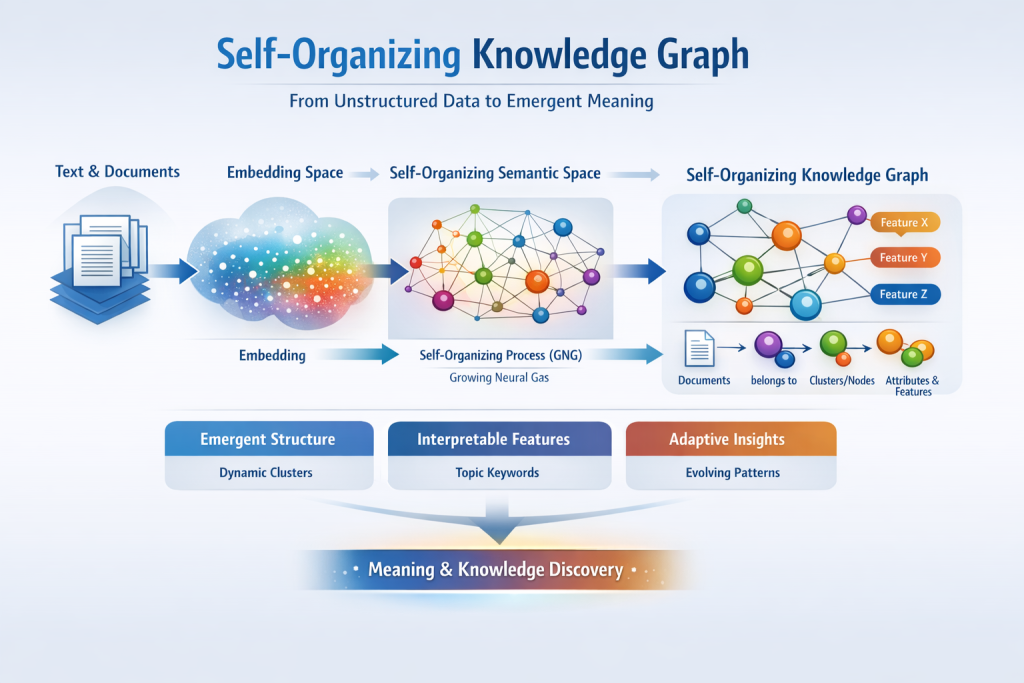
ConceptMiner combines technologies such as text embedding, dimensionality reduction, GNG (Growing Neural Gas), and MST (Minimum Spanning Tree) to model the semantic relationships between document and idea groups as a network.
This model enables the following types of analysis:
- Grasp the overall picture of large amounts of text information
- Organize similar opinions, concepts, and points of contention into clusters
- Discover important themes and related themes
- Explore potential structures that are difficult to see with existing classifications
- Derive deeper questions and hypotheses through dialogue with LLM
- Realize a structure-search type AI application that differs from RAG and Graph RAG
ThinkNavi is a thinking support application using ConceptMiner as an engine.
Users can explore conceptual structure models through interaction with AI and utilize them for research, planning, analysis, and strategy formulation.
The concept of Self-Organizing RAG+
At Mindware Research Institute, we position the technological concept of ConceptMiner/ThinkNavi as Self-Organizing RAG+.
A typical RAG is a system that searches for relevant documents in response to a user’s question and has an LLM generate an answer.
On the other hand, Self-Organizing RAG+ aims to organize a collection of documents and text chunks into a semantic structure in advance, and then query the AI while exploring that structure.
In other words, it is not simply a search extension, but emphasizes the following functions:
- Creating a semantic map of information
- Understanding the proximity and distance between concepts
- Discovering clusters of arguments and gaps between the clusters
- Helping users arrive at better questions
- Utilizing AI answers within a structured context
This allows AI to be used not only as an “answer generation tool,” but also as a system to support companies’ intellectual exploration, research, hypothesis formation, and strategic consideration.
Self-organizing Knowledge Graph
Mindware Research Institute has evolved its conceptual structure model into a self-organizing knowledge graph (SOKG) that generates representations in the form of a knowledge graph. While conventional knowledge graphs could only handle explicit knowledge and had high design costs, SOKG is an “epistemological machine” that creates concepts from data, and is distinct from the automatic generation of conventional knowledge graphs that generate “ontology networks”. >Read White Paper
2. Data Mining
Map-based clustering using SOM
Mindware Research Institute has been working on data mining using Self-Organizing Maps (SOMs) for many years.
SOMs are a method for visually understanding data similarities and cluster structures by arranging multidimensional data on a two-dimensional map.
They are particularly suitable for the following applications:
- Customer segmentation
- Product/service positioning analysis
- Understanding the structure of survey data
- Overview of mixed numerical and categorical data
- Characteristic analysis of each cluster
- Consideration of marketing and sales strategies
SOM (Structure of Data) is a useful analytical method not only for experts but also for business decision-makers because it can represent the underlying structure of data in an intuitively understandable way.
However, for ultra-high-dimensional data such as recent text embeddings, SOM based solely on a fixed two-dimensional topology may have limitations.
Therefore, Mindware Research Institute is building upon its SOM expertise while developing more flexible conceptual network modeling techniques using GNG (Growing Neural Gas) and MST (Minimum Spanning Tree).
Causal and probabilistic inference using Bayesian Belief Networks
Mindware Research Institute also supports probabilistic modeling using Bayesian belief networks.
A Bayesian belief network is a method that represents the dependencies between multiple factors as a network and probabilistically infers how changes in certain conditions affect other factors.
It is suitable for the following applications:
- Analysis of customer behavior factors
- Prediction of purchase, churn, and satisfaction
- Risk assessment
- Decision support
- Hypothesis testing
- Scenario analysis
- Integration of expert knowledge and data
While typical machine learning models prioritize “predictive accuracy,” Bayesian belief networks are characterized by their ability to represent relationships between factors and the effects of changing conditions in an easily understandable way.
Therefore, they are effective in areas where explainability and decision support are required, rather than being mere black-box AI.
Unlike many startups that have entered the AI business riding the recent AI boom, Mindware Research Institute has experienced many years of technological advancement simultaneously, giving us the strength to utilize a wide range of elemental technologies.
3. AI system development technology
Experience in developing SaaS-based AI applications
Mindware Research Institute has been working not only on AI analysis engines, but also on developing web applications, SaaS, and authentication/billing systems to actually use them.
Our main development technologies include the following:
- Python
- Streamlit
- React
- Express
- Next.js
- Tailwind CSS
- shadcn/ui
- PostgreSQL
- JWT Authentication
- Stripe API
- Cloudflare R2
- REST API
- External LLM API Integration
- SaaS-based User Management
- Billing and Subscription Management
- Usage-based Metering Design
By combining these technologies, we can build practical AI systems that include AI engines, user interfaces, authentication, billing, data storage, and external API integration.
In particular, to ensure that AI technology is not merely experimental but is actually used in business systems and paid services, application development, security, billing, and operational design are essential, in addition to model development.
Mindware Research Institute places great importance on implementation capabilities that connect AI models with business applications.
Technical elements required for enterprise AI systems
Simply calling LLM via API is insufficient for implementing an AI system in a company.
A practical AI system requires the following elements:
Data processing and preprocessing
This process involves formatting internal documents, CSV files, PDFs, web information, meeting minutes, customer feedback, and other data into a format that is easily usable by AI.
Specifically, this includes text extraction, chunking, metadata addition, duplicate removal, cleaning, and categorization.
Embedding, search, and structuring
It vectorizes text and documents, enabling searching, classification, and clustering based on semantic similarity.
In addition to general vector search, ConceptMiner organizes document sets as a conceptual structure network, making it possible to explore the overall structure.
LLM Integration
We utilize LLM APIs such as the OpenAI API to perform natural language question answering, summarization, classification, extraction, report generation, and hypothesis generation.
Depending on the application, we perform prompt design, RAG (Retrieval-Augmented Generation), tool integration, agent-based processing, and model selection.
Authentication and access control
Enterprise systems require proper management of who can access which data.
This involves designing JWT authentication, user management, role management, and organizational-level access control.
Billing and usage management
When offering this as a SaaS, subscription billing, usage-based billing, usage monitoring, and plan management using APIs such as Stripe are necessary.
Since using AI APIs incurs costs, understanding and controlling usage is especially important.
Data storage and file management
Securely store and manage analysis data, generated results, model files, user settings, reports, and more.
Combine PostgreSQL, Cloudflare R2, and other cloud storage services as needed.
UI/UX design
Even the most technically advanced AI systems are useless if users cannot effectively utilize them.
We design chat UIs, dashboards, analytics views, graph displays, report outputs, and screen layouts that align with business workflows.
Security and operational design
For enterprise-level AI systems, it’s necessary to consider factors such as information leakage, access control, log management, API key management, and data retention policies.
Furthermore, to ensure continuous operation beyond a proof-of-concept (PoC), maintenance, monitoring, error handling, version control, and backup design are also crucial.
4. Supported development areas
Mindware Research Institute can handle the following AI, data analysis, and system development needs:
AI research and analysis system
This system collects and organizes large amounts of information, and uses AI to summarize, classify, compare, extract key issues, and generate hypotheses.
Example uses:
- Market research support
- Competitor research support
- Technology research support
- New business theme exploration
- Industry trend report generation
- Analysis of web articles, papers, and patent information
Customer feedback (VoC) and internal feedback analysis system
We analyze surveys, inquiries, reviews, sales memos, meeting minutes, etc., to structure the key issues contained in customer and employee feedback.
Example uses:
- VOC analysis
- Analysis of factors affecting customer satisfaction
- Identification of product/service improvement themes
- Analysis of employee awareness surveys
- Visualization of organizational issues
- Analysis of call center records
AI utilizing internal knowledge
This AI system utilizes internal company documents, manuals, FAQs, reports, meeting minutes, etc., to perform question answering and knowledge retrieval.
Example uses:
- Internal inquiry AI
- Business manual search
- Knowledge base AI
- Meeting minute structuring
- Internal document summarization and comparison
- Cross-departmental knowledge sharing
Decision support and strategy support systems
We combine qualitative and quantitative data to support the examination of management challenges and business opportunities.
Examples uses:
- Management Challenge Mapping
- Business Portfolio Analysis
- New Business Idea Evaluation
- Competitive Positioning Analysis
- Risk Factor Analysis
- Scenario Analysis
SaaS-based AI service development
We develop web services and business applications that incorporate AI functionality.
Example uses:
- AI Analytics SaaS
- Membership-based AI Service
- Charged AI Application
- User-Specific Data Management System
- API-Integrated AI Tool
- Business-Specific AI Concierge
5. Characteristics of Mindware Research Institute
Development based on an understanding of both AI and data mining.
Much of AI development focuses on chat and automated generation using LLM (Language Literacy Modeling).
Meanwhile, traditional data analysis has primarily developed around quantitative (numerical and categorical) data and structured data.
Mindware Research Institute aims to develop systems that integrate unstructured qualitative information with quantitative data, leveraging expertise in both AI and data mining.
Proprietary technology for handling conceptual structures
ConceptMiner’s distinguishing feature lies in its approach of modeling text not simply as searchable material, but as a relational structure between concepts.
This is a different approach from typical chatbots, RAGs, vector searches, and dashboard-based BI.
By treating the collection of information as a “map of meaning,” users can grasp not just search results, but the overall picture, key issues, relationships, and unexplored areas.
Support from Proof of Concept (PoC) to SaaS implementation
Mindware Research Institute has not only verified analytical algorithms, but has also developed usable web applications, SaaS, and authentication/billing systems.
Therefore, we can provide development support tailored to each stage of AI technology, from PoC (Proof of Concept) and business prototypes to internal systems and external SaaS.
Supports small-scale and phased development
Rather than building an AI system on a large scale from the start, it’s more practical to begin with a small proof-of-concept (PoC) and gradually expand it while verifying its effectiveness using actual business data.
At Mindware Research Institute, we support smooth implementation through a process that includes clarifying initial hypotheses, verifying data, developing prototypes, testing, improving, and then full-scale development.
6. Anticipated consultation topics
Please contact us if you are experiencing any of the following challenges.
- We have a large amount of documents and meeting minutes within the company, but we are not utilizing them effectively.
- We want to analyze customer feedback and surveys using AI.
- We want to streamline competitive and market research.
- We want to create a custom AI analysis tool for our company.
- We introduced ChatGPT into our operations, but the responses are fragmented, making it difficult to grasp the overall picture.
- We introduced RAG, but we are not gaining insights beyond the search results.
- We want to cluster and visualize qualitative information.
- We want to analyze a combination of numerical and text data.
- We want to plan and develop a SaaS-type AI service.
- We want to create an AI application that includes authentication, billing, and user management.
7. Support we can provide
Mindware Research Institute can provide support in the following ways:
- AI system planning
- PoC design
- Prototype development
- Conceptual structure analysis using ConceptMiner / ThinkNavi
- Data mining analysis
- LLM API integration
- RAG / Self-Organizing RAG+ type system design
- SaaS application development
- Authentication and billing system construction
- Data preprocessing and analysis pipeline construction
- AI implementation consulting for enterprises
- Business commercialization support for AI-utilizing services
8. Conclusions
The goal is not just to “use” AI, but to transform the structure of intellectual work.
AI is evolving from a tool for generating text to a foundation for leveraging a company’s knowledge, experience, customer feedback, and research information.
However, simply implementing an LLM (Language-Level Modeling) is insufficient to truly utilize AI in business operations.
A system is needed to organize, structure, search, explore, and translate information into decision-making.
Mindware Research Institute integrates AI, data mining, and system development technologies to support companies in developing systems that enhance their intellectual operations.
Leveraging our experience in conceptual structure network modeling using ConceptMiner/ThinkNavi, data mining using SOM (System-Based Manifestation) and Bayesian belief networks, and SaaS-type AI application development, we build practical AI systems tailored to the specific challenges of each company.
The Vision of Mindware Research Institute