To all small business professionals, including management consultants, training instructors, licensed professionals, and web design firms and so on.
This is your chance to join the ranks of AI providers.
AI is poised to dramatically alter the structure of society. It is said that the jobs that will be replaced by AI are not simple labor, but specialized knowledge work. AI’s capabilities have now reached a level where it can refine doctoral-level research ideas and even write academic papers. While jobs requiring national qualifications, such as doctors and lawyers, cannot currently be replaced by AI due to systemic limitations, AI already possesses more perfect knowledge than any expert when it comes to pure “specialized knowledge.”
For example, you can get instant answers to questions about various management methods, human resources and labor, and government procedures by asking AI. We’re now in an era where even website design and coding can be done by AI. In this age, how can specialist small businesses that sell their expertise and skills survive? One way is to value “personal connections (networks)” more than ever before. A second is to actively use AI themselves to streamline operations. And a third way might be to leverage your AI skills and know-how to “become an AI provider.”
Mindware Research Institute is an AI company that develops and operates ThinkNavi, a thought support system developed by combining the philosophy of Conceptual Investigation with AI and machine learning technologies. Moreover, it’s not a newcomer that entered the market riding the recent AI boom; it’s a long-established company that started with fuzzy reasoning in the 1980s and has followed the flow of “flexible information processing” (soft computing), including self-organizing maps (SOMs) and Bayesian belief networks (BBNs). (As such, it possesses a wealth of technical expertise.)
Mindware Research Institute has chosen to partner with experts to promote the adoption of business AI systems in companies moving forward. This collaborative program begins with you using ThinkNavi as a platform for your consulting activities, and then leveraging that experience to participate in “initial assessments” for companies looking to implement AI systems. This will allow you to multiply the value of your experience, expertise, and professional network many times over.
Your clients, the companies you work with, are in the process of transitioning from basic ChatGPT implementation to the development and deployment of dedicated AI systems for business use. If you miss this opportunity, you may never get another chance to become an AI provider. We strongly encourage you to consider this opportunity.
What is a Conceptual Investigation
Exploring a future without a blueprint, starting from conceptual frameworks.
AI, robotics, biotechnology, energy, space exploration, quantum technology.
We are currently in the midst of a “big wave” of multiple innovations happening simultaneously.
The world will not be the same before and after innovation.
The meaning of work, customer needs, the competitive landscape for companies, the way organizations function, and even daily life itself will change dramatically.
However, here’s the problem: we can’t see what the world will look like after the changes.
Thinking about the future is like putting together a jigsaw puzzle without a complete picture.
At your fingertips are countless pieces: customer voices, employee opinions, meeting minutes, competitor information, technology news, research information, management intuition, and on-the-ground observations. However, no one can clearly see what kind of future these pieces will form.
Conceptual research is a new research and thinking support method needed in such times. Exploring the meaningful connections hidden between fragmented information, discovering possibilities that have not yet been put into words, and identifying the next questions and hypotheses to consider—that is the role of conceptual research.
Mindware Research Institute aims to expand this conceptual research as a new consulting practice in the AI era.
First, what we want to tell you
What we want to spread is not just a tool. What we want to spread is the method of conceptual research.
(Just as Descartes’ Discourse on Method opened the door to the modern spirit, we now need a method to lay the foundation for a new spirit in the AI era.)
ThinkNavi / ConceptMiner is a technological platform that supports conceptual research. However, our essence is not “selling software,” but rather spreading conceptual research as a method of exploring the future to society, together with consultants, professionals, training instructors, facilitators, and researchers.
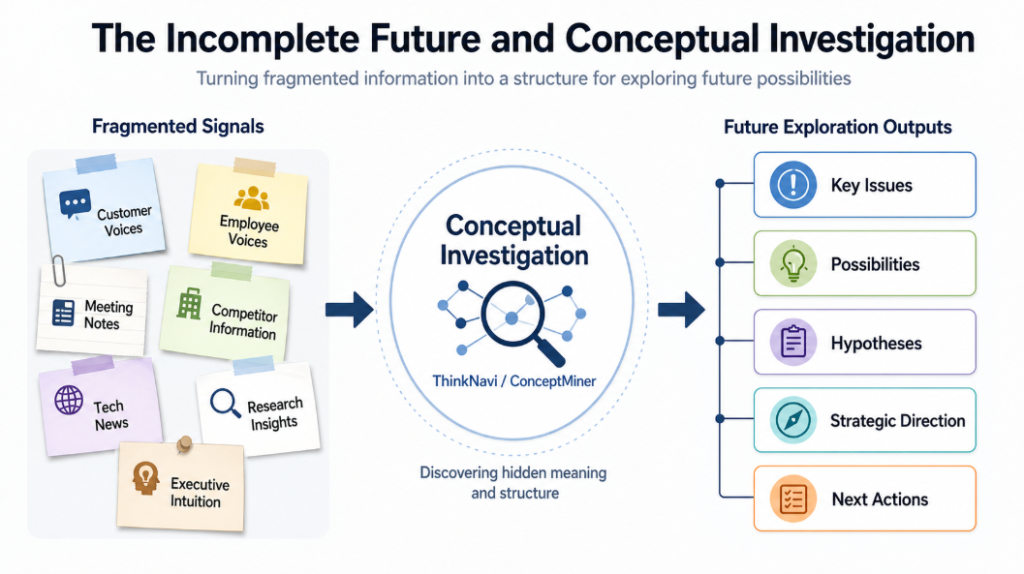 Transforming fragmented information into a structure for exploring the future.
AI and Conceptual Investigation
The initial idea for a conceptual survey emerged in 1994, when the commercialization of the internet began. Japanese corporations were still grappling with the aftermath of the bubble economy’s collapse, and despite predictions that “the internet will become a major industry,” they were completely paralyzed. Such a clear future was not visible to those in power within these organizations, preventing them from making timely decisions.
In the 1980s, there was a boom in discourse on the advanced information society, and within that context, predictions that computer communications would drastically change society were already being made. However, looking back now at what was said then, I am struck by how idealistic it all was. After the spread of the internet and smartphones, I never imagined that our daily lives would be so surrounded by fraud, crime, and security risks. Experiencing the innovation process is like putting together a jigsaw puzzle without knowing the final picture.
As a method for organizing disparate information and discovering the overall structure, the KJ method, devised by cultural anthropologist Jiro Kawakita in the 1960s, already existed. While it had some effect in sharing the thoughts of members within an organization, when viewed purely as a method of information analysis, it had many drawbacks, such as being arbitrary, easily influenced by organizational hierarchies, and inefficient. However, the principle itself—grouping disparate qualitative information by similarity, extracting common characteristics within the group, and describing their relationships—corresponds well with the concepts of statistical analysis performed with quantitative data, and had the potential to become a scientific method if the technology was in place. In other words, it did not become a scientific method because the technology was lacking.
Thirty years after the commercialization of the internet, a breakthrough occurred with the ability to quantify (vectorize) the “meaning” of qualitative information (natural language text) using LLM (Large-Scale Language Modeling). Mindware Research Institute had been handling data mining technologies such as SOM (Self-Organizing Map) since 1999, so from 2023, we began working on creating qualitative information maps by combining LLM and SOM. After many experiments, in 2025 we completed ConceptMiner, a technical tool for conceptual research, using a conceptual structure model technology that combines GNG (Growing Neural Gas) and MST (Minimum Spanning Tree), and subsequently developed ThinkNavi, a thought support system, as its application UI layer.
The reason why this can replace conventional qualitative information analysis and the KJ method is that (1) while human language can only express meaning discretely and humans can only perceive space through two-dimensional images, AI far surpasses human cognitive abilities by being able to manipulate meaning using continuous values in a hyper-multidimensional space, and (2) since it is difficult to fully understand each other’s intentions when communicating with AI via chat, data mining technology can bridge that gap. ThinkNavi allows you to communicate with AI using a multidimensional coordinate space as a common language, similar to the KJ method.
With this technological backing, conceptual research has become a research method that uses AI and conceptual structure models to organize large amounts of qualitative information, such as customer feedback, meeting minutes, free-response texts, interviews, competitor information, and technical information, in order to discover new points of discussion and hypotheses.
Traditional research often relies on existing classification axes. It organizes information along known markets, categories, needs, and competitive axes. This is effective in itself.
However, in the midst of a major wave of innovation, this is insufficient.
This is because truly important possibilities often lie outside of existing categories.
Conceptual research, on the other hand, does not rely too heavily on fixed classification axes from the outset, but instead explores the meaningful connections, similarities, discrepancies, conflicts, and gaps hidden within the information. Its purpose is not simply summarization or classification.
Conceptual research aims to answer questions such as:
- Within this collection of information, what are the truly important points?
- How are seemingly separate statements and issues connected?
- What are the needs that customers and employees have not yet clearly articulated?
- What perspectives are being overlooked in meetings and workshops?
- What hypotheses should be tested next?
- What assumptions are causing the organization to fall into a state of intellectual stagnation?
Conceptual Investigation is not merely a method for processing large amounts of information. It is a method for exploring future possibilities from fragmented information in an era where the final picture is unclear.
Why are we looking for a partner?
Ideally, Mindware Research Institute itself would employ many consultants and spread its conceptual research to society. However, in reality, there are limits to what one company can achieve.
On the other hand, there are already many experts in the world who are involved in identifying customer problems and supporting decision-making.
- Management Consultant
- Small and Medium Enterprise Management Consultant
- New Business Development Support Specialist
- Human Resources and Organizational Development Consultant
- Training Instructor
- Workshop Facilitator
- Marketing Researcher
- Social Insurance and Labor Consultant
- Tax Accountant/Certified Public Accountant
- AI Implementation Support Specialist
- Various Professionals and Experts
These individuals already deal with the following types of information on a daily basis:
- Meeting minutes
- Interview records
- Open-ended questionnaire responses
- Customer interviews
- Employee testimonials
- Management consultations
- Competitor information
- Workshop results
- Various documents and notes
In other words, the “pieces” necessary for a successful conceptual Investigation already exist in the fields of many experts.
Therefore, we want to expand conceptual Investigation by collaborating with various experts, rather than keeping conceptual Investigation to ourselves. We are not simply looking for sales agents. We are seeking practitioners who can combine conceptual Investigation with their own expertise to support their clients’ thinking and decision-making.
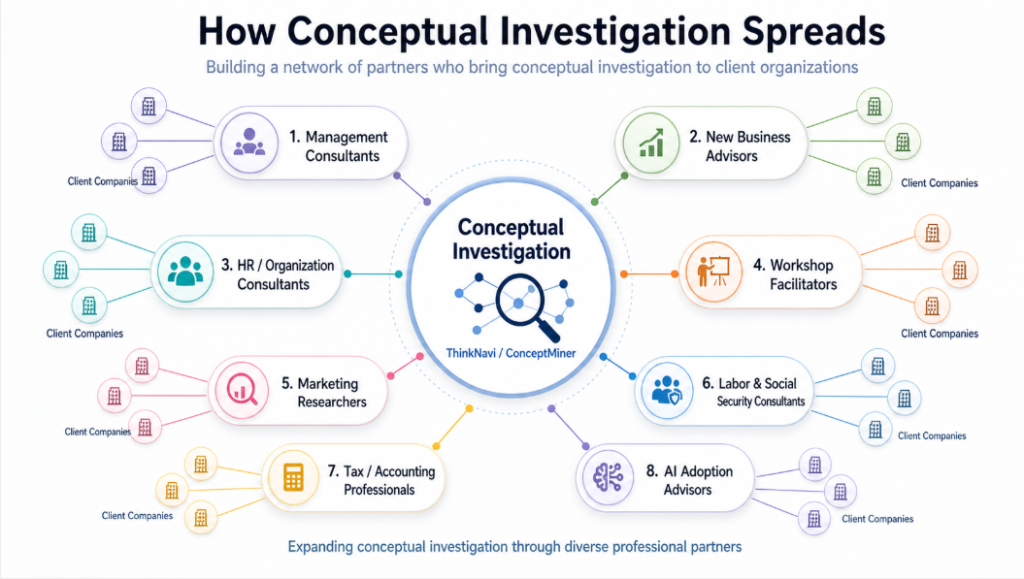 Instead of expanding within a single company, we will expand to society in collaboration with diverse experts.
This is suitable for people like this:
- Those who want to add new, high-value-added services to their existing consulting and support offerings.
For example, those who want to add AI-powered conceptual structure analysis to meeting support, workshops, management consultations, HR support, customer analysis, etc.
- Those who feel that ChatGPT alone is not enough to differentiate themselves.
Those who want to go beyond simple text generation and delve into structuring, issue identification, and hypothesis formation.
- Those who don’t want meeting minutes and open-ended responses to end as mere minutes or summaries.
Those who want to see the connections between the meanings behind statements and descriptions more deeply.
- Those looking for new services to offer to existing clients.
Those who want to enhance analysis, reporting, and strategic support while leveraging current customer touchpoints.
- Those who want to extend KJ method, qualitative analysis, facilitation, and strategic hypothesis building with AI.
Those who want to strengthen, rather than replace, existing practices.
Examples of services our partners can offer
Our consulting partners can utilize ThinkNavi/ConceptMiner to offer the following services as part of their service offerings:
1. AI-KJ Method for Meeting and Workshop Analysis
Example Deliverables:
- Grouping of Comments/Ideas
- Key Point Map
- KJ Method-Style Chart
- Overlooked Perspectives
- Next Meeting Agenda
- Potential Actions
Example Targets:
- Management Meetings
- New Business Workshops
- Organizational Development Sessions
- Training
- DX Promotion Meetings
- AI Implementation Review Meetings
2. AI Customer Insight Analysis
We analyze customer reviews, open-ended responses, inquiry history, and interview records to structure customer dissatisfaction, expectations, and latent needs.
Example Deliverables:
- Structure of Customer Issues
- Potential Latent Needs
- Improvement Themes
- Suggestions for Appeal Messages
- Issues by Segment
- Next Questions
3. AI Organizational Challenge Mapping
We analyze employee surveys, 1-on-1 notes, resignation interview records, training questionnaires, and open-ended responses from organizational surveys to structure organizational issues.
Example Deliverables:
- Structure of organizational issues
- Identification of factors contributing to employee turnover
- Engagement improvement themes
- Management challenges
- Perception gaps between departments
- Direction of measures
4. AI Business Challenge Mapping
We analyze management interviews, executive meetings, monthly meetings, business plan memos, and pre-subsidy application concepts to organize management challenges and countermeasures.
Example Deliverables:
- Overall Structure of Management Challenges
- Key Issues
- Priorities
- Business Improvement Themes
- New Theme Candidates
- Next Questions to Consider
5. AI Competitive Positioning Analysis
We collect and analyze competitor product pages, reviews, comparison articles, press releases, and user feedback to identify differences between competitors and unmet market positions.
Example Deliverables:
- Competitive Positioning Map
- Differentiation Axes
- Competitor Characteristics Summary
- Unmet Needs
- Target Position for Your Company
- Suggestions for Product/Service Improvement
6. Exploring new AI business themes
We integrate market information, technical information, customer challenges, competitor information, and internal ideas to discover new business themes and hypotheses.
Example Deliverables:
- Candidate business opportunities
- Matching customer challenges and technological seeds
- Structure of idea groups
- Extraction of promising themes
- Hypotheses to be tested
- Proposed business concepts
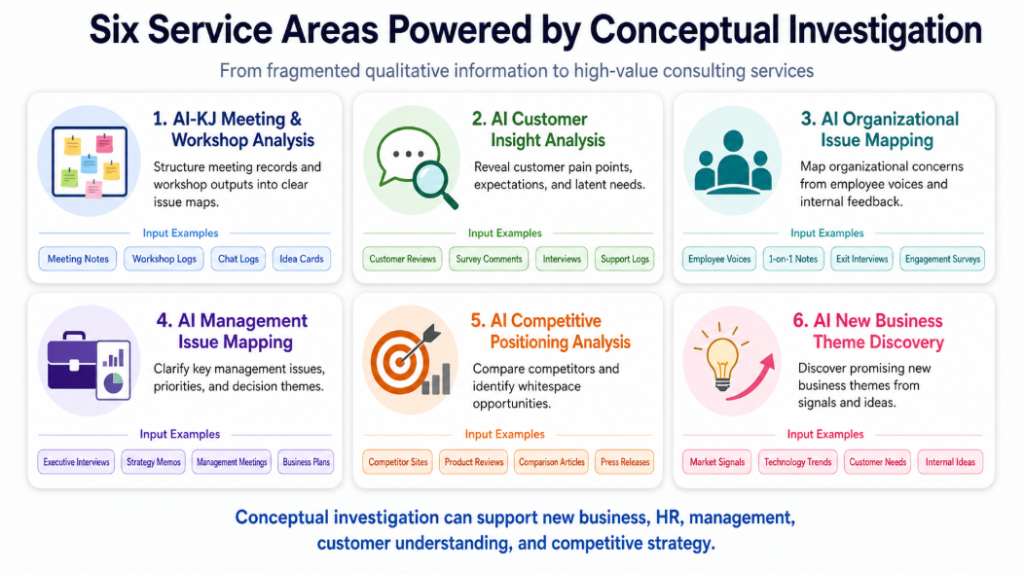 Conceptual Investigation can be applied not only to new business ventures, but also to human resources, management, customer understanding, and competitor analysis.
Benefits for the partner
1. You can add new, high-value-added menu items to your own services.
AI-powered conceptual structure analysis can be integrated into existing consulting, training, research, and professional services. For example, in addition to traditional meeting support and interviews, you can offer proposals such as:
- Using AI to structure meeting minutes and create KJ-style issue maps
- Structuring customer feedback to visualize latent needs
- Structuring management consultations to organize business challenges
These are just some of the proposals that become possible.
2. It can enhance the appearance and persuasiveness of deliverables.
ThinkNavi allows you to analyze data and use AI chat and PowerPoint to create easy-to-understand deliverables such as KJ method-style charts, positioning maps, issue maps, and conceptual structure reports.
Deliverables that show structure are easier to understand and accept than simple meeting minutes or written reports.
3. You can make a joint proposal with Mindware Research Institute.
Mindware Research Institute will provide technical explanations, analysis support, proposal writing, and report writing assistance as needed.
You can also provide advanced AI analysis services that would be difficult to propose on your own, in collaboration with technology partners.
4. It becomes easier to make additional proposals to existing customers.
Conceptual Investigation can be used not only for new business development but also as an additional proposal option for existing customers.
- Meeting minutes analysis
- Customer feedback analysis
- Employee feedback analysis
- Management challenge analysis
- Competitor analysis
- New business theme exploration
- Challenges before AI implementation
This is a topic that is easier to implement for professionals who already have relationships with their clients.
5. This will lead to differentiation as an expert.
Simply using generative AI makes it difficult to differentiate oneself as an expert.
Conceptual Investigation focuses not merely on summarization or text generation, but on structuring, issue identification, hypothesis formation, and decision support.
This is not a replacement for expert judgment and experience, but rather a way to enhance them.
Support provided by Mindware Research Institute
Mindware Research Institute provides the following support to its partners:
- ThinkNavi Usage Environment
- Basic Training for Concept Research
- Proposal Template
- Deliverable Template
- Sample Analysis Materials
- Customer Presentation Materials
- KJ Method Chart Creation Prompt
- Positioning Map Creation Prompt
- Initial Project Analysis Support
- Joint Proposal Support
- Report Creation Support
- Technical Explanation Support
In the initial stages, partners don’t need to handle and analyze everything on their own.
You can start with a collaborative implementation model where partners understand customer challenges, and Mindware Research Institute supports the analysis and report creation.
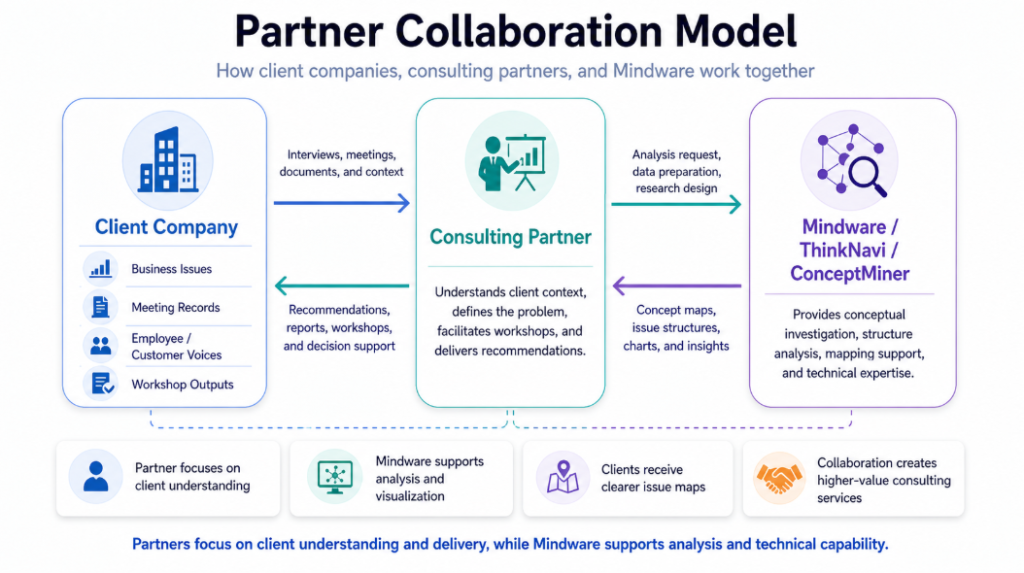 Our partners focus on understanding the customer and making proposals, while Mindware Research Institute provides support in terms of analysis and technology.
Expected procedure
Step 1: Individual Explanation
First, we will explain the concept research, ThinkNavi, and the partner program.
We will then discuss how the concept research can be incorporated into your current area of expertise, customer type, and services offered.
Step 2: Confirmation of sample analysis
You will see sample analyses using meeting minutes, open-ended survey responses, customer feedback, and competitor information.
If possible, we will use samples that are close to the interests of potential partners.
Step 3: Create a service menu
We design menus that can be proposed to clients, tailored to their area of expertise.
For example:
- AI-KJ Method Meeting Analysis
- AI Customer Insight Analysis
- AI Organizational Issue Mapping
- AI Management Issue Mapping
- AI Competitive Positioning Analysis
- AI New Business Theme Exploration
Step 4: Joint implementation of the initial project
For the initial project, Mindware Research Institute will handle analysis, report creation, and proposal support.
Partners can then focus on customer interviews, problem identification, reporting, and follow-up.
Step 5: Ongoing Partner Activities
As we build on our track record, we will enable our partners to continue offering concept research services as part of their own service offerings.
Revenue Model
This program envisions a flexible revenue model depending on the nature of the project.
Referral model
This model involves a partner referring a client, with Mindware Research Institute acting as the main contractor to execute the project. In this case, a referral fee will be paid based on the contract value.
Joint Implementation Model
This is a model jointly proposed and implemented by our partner and Mindware Research Institute.
The partner is responsible for customer support, interviews, reporting, and expert interpretation, while Mindware Research Institute is responsible for analysis, model creation, report support, and technical explanations.
Revenue sharing will be determined individually based on the project content and scope of responsibility.
Partner-Led Contract Model
This model involves partners contracting with customers for their own services, with Mindware Research Institute providing analysis support, tools, and technical assistance.
In this case, Mindware Research Institute will charge a fee for analysis support or usage on a per-project basis.
Price image
Pricing for customer services varies depending on the project size and deliverables, but the following ranges can be expected:
| Services | Estimated price |
|---|
| Analysis of individual meeting minutes and workshops | $700-$2,000 |
| AI-KJ Method Workshop Analysis | $2,000-$5,400 |
| Customer and employee feedback analysis | $2,000-$7,000 |
| Management Challenge Mapping | $2,000-$7,000 |
| Competitive Positioning Analysis | $3,400-$10,000 |
| Exploring new business themes | $5,400-more than $13,400 |
The above is merely an estimate.
Actual pricing will be adjusted based on the amount of data, scope of analysis, whether a presentation is required, the scope of report creation, and the depth of expert interpretation.
FAQ
Q. Do I need to be fully proficient with ThinkNavi to participate?
No. In the initial stages, Mindware Research Institute will support analysis and report creation.
Partners can focus on understanding customer challenges, providing expert interpretation, reporting, and making proposals.
Q. Can I offer this as a service to my own clients?
Yes. You can offer the concept study as part of your own consulting, training, research, or professional services.
Q. Do members of the client company also need to use ThinkNavi?
Not necessarily.
In the initial stages, it is sufficient for partners to use ThinkNavi for analysis, explain the findings via screen sharing on Zoom, or deliver them as PowerPoint reports.
Q. Is integration with Zoom or Teams necessary?
Not mandatory.
You can analyze Zoom and Teams transcripts, meeting minutes, and chat logs by inputting them into ThinkNavi. While integration features can be considered in the future, manual data import is sufficient for the service at present.
Q. Can I create KJ method charts and positioning maps?
Yes. ThinkNavi allows you to create conceptual structure models, and based on the analysis results, you can create KJ method-style charts, issue maps, and positioning maps using AI chat and PowerPoint.
Q. Can I get project referrals?
This program does not guarantee project referrals.
However, depending on the content of the consultations received by Mindware Research Institute, we may collaborate with or refer partners who match your expertise, region, and experience.
Q. Can professionals such as tax accountants, certified public accountants, social insurance and labor consultants, and small and medium-sized enterprise consultants participate?
However, ThinkNavi is not a substitute for professional judgment. It supports information organization, issue extraction, customer understanding, and problem structuring in the preliminary stages before professional judgment.
What we aim for
We want to cultivate concept research not merely as a way to use AI tools, but as a new intellectual practice for the AI era.
AI can generate text, summarize information, write code, and create images.
However, what’s truly important for businesses and organizations isn’t simply accepting the answers AI provides.
The key is structuring the meaning behind the information and discovering what they should be thinking.
Conceptual Investigation is a method for doing just that.
We are looking for experts who can help us spread this method.
Not just sales agents.
We are looking for practitioners who can integrate Conceptual Investigation with their expertise to support clients’ thinking and decision-making.
Start with an individual consultation
If you are interested in becoming a ThinkNavi Consulting Partner, please start by requesting an individual consultation using the form below.
We will discuss your current area of expertise, client base, and services offered, and together we will explore how ThinkNavi/ConceptMiner can be utilized.
You don’t need to understand advanced AI technology or tool operation from the start.
What is needed is a strong desire to deeply understand customer challenges, organize information, and find better questions and solutions.